
Quick Takeaways
– You can build a functional AI agent without writing a single line of code using platforms like Zapier or Make.
– Start with a bounded, high-value use case. Email triage is the ideal first build for almost any business type.
– The most important step is writing clear, testable AI instructions with an explicit, structured output format.
– No-code agents work best for reversible, repetitive tasks. Complex logic or hard real-time requirements may call for an engineer.
– Human review is not optional for consequential actions. Build it into your workflow from day one, not as an afterthought.
Most business owners do not need a development team to automate a real task with AI. What they need is a clear starting point and an honest walkthrough. If you have been wondering whether you can build an AI without coding, the short answer is yes, provided the task is narrow, your platform already connects to the apps involved, and a person still reviews anything consequential. This guide will show you exactly how to create an AI agent without coding, using a practical, end-to-end example you can replicate in an afternoon.
We are not going to promise that a no-code agent will replace your operations team. What we will do is walk you through building something genuinely useful today, show you where to install guardrails so the agent does not cause problems, and be honest about where these tools hit their ceiling. If you decide you need more capability after reading this, we can talk about that too.
What Is a No-Code AI Agent?
A no-code AI agent is an automated workflow that uses an AI model to observe an event, make a decision or classification, and take one or more actions. All of this is configured through a visual, drag-and-drop interface rather than written code. Think of it as a very focused digital team member who watches for a specific trigger, applies reasoning to what it finds, and routes the result somewhere useful.
The term “agent” is used broadly right now, so a grounded definition helps. For small and mid-sized businesses, a practical working definition is this: an agent is a workflow that combines at least one AI step, such as classification, summarization, or drafting, with at least one downstream action, such as logging, labeling, or notifying. It is distinct from a simple chatbot because it acts on data rather than just responding to prompts in a conversation window. For the wider category and realistic business use cases, read our guide to AI agents for business.
Platforms like Zapier’s AI steps, Make’s AI Agent modules, Slack Workflow Builder with AI steps, Microsoft Copilot Studio, and Google Vertex AI Agent Builder all give non-technical users visual canvases to configure these agentic AI workflows without touching a single line of code. The platforms handle the infrastructure; your job is to define the logic clearly.
Why the Timing Is Right
Adoption of AI at work has moved from early experiments to mainstream behavior with striking speed. Microsoft and LinkedIn’s 2024 Work Trend Index, based on a survey of 31,000 people across 31 countries, reported that 75 percent of knowledge workers were using AI at work. McKinsey’s early-2024 global survey found that 65 percent of organizations were using generative AI regularly, nearly double the share reported in the previous survey ten months earlier.
Agentic AI, meaning AI that takes actions rather than just generating text, is the next practical frontier. Gartner’s 2026 Hype Cycle for Agentic AI, drawing on the 2026 Gartner CIO and Technology Executive Survey, reports that only 17 percent of organizations have deployed AI agents so far, while more than 60 percent expect to within the next two years. Organizations that build and govern agentic AI workflows now will have a meaningful head start over those waiting for the technology to fully mature.
For small and mid-sized businesses, the practical takeaway is straightforward: a first agent now costs a monthly platform subscription and an afternoon of configuration, not a development contract. The rest of this guide walks through that afternoon, step by step.
The Agent We Are Building: Email Triage
There are many possible first AI agents: a research-and-summarize agent, a lead-scoring agent, a content brief generator. We are walking through an inbound email triage agent because it is a controlled, high-leverage starting point for almost any business type and illustrates every principle you will apply to future builds.
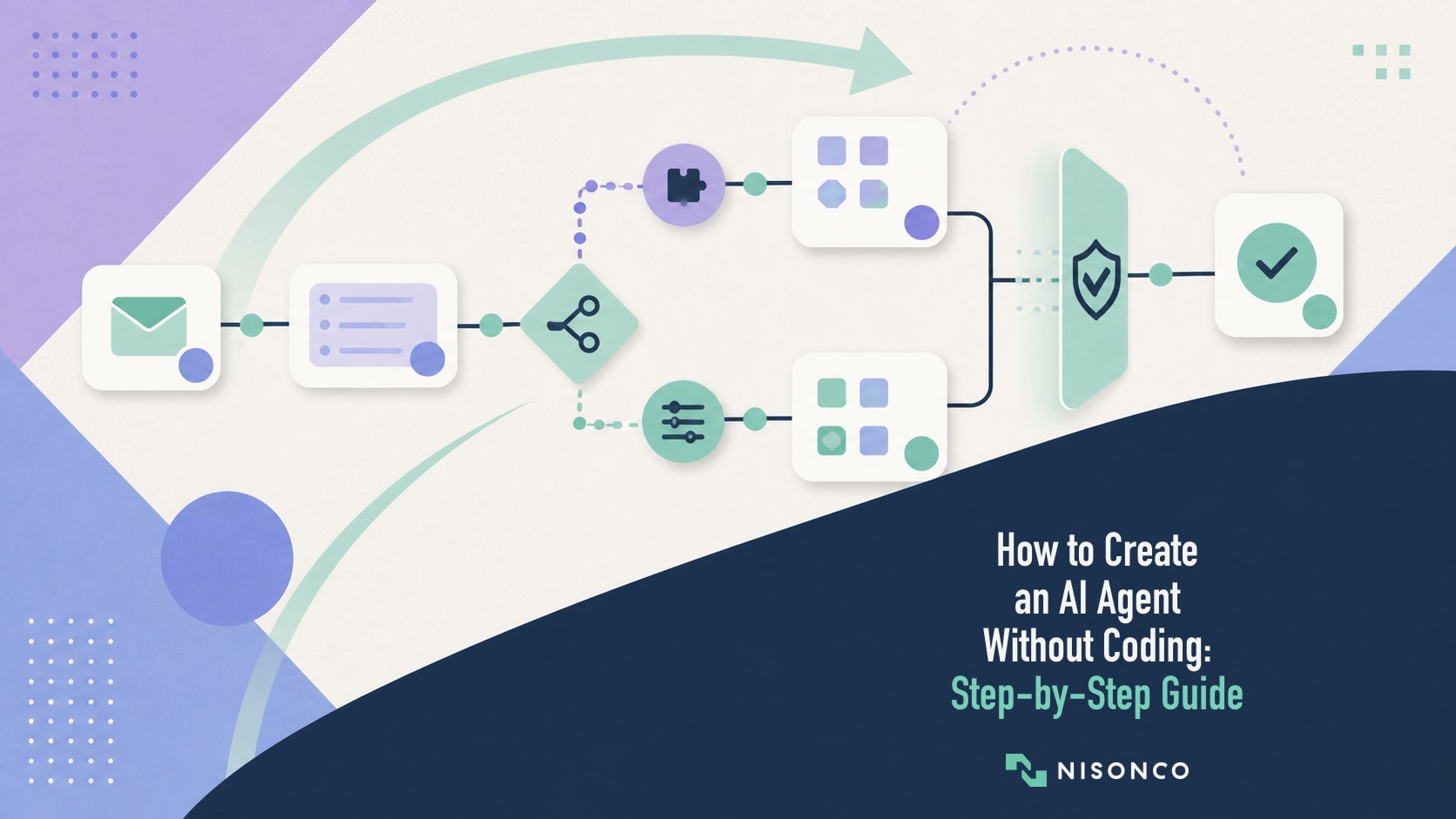
Here is the scenario: your team shares an inbox for general inquiries. Right now, someone reads every email and manually decides where it goes. It is repetitive, it takes real time, and things fall through the cracks during busy periods. The agent we are building will watch that inbox, classify each new message into a defined category, generate a one-to-two sentence summary, log the message to a shared spreadsheet, notify the right team member in Slack, and flag anything uncertain for human review. The agent does not send replies on its own. That stays with your team.
This design is intentional. Starting with reversible, audit-friendly actions like labeling, logging, and notifying is the right approach before you give any AI-powered workflow automation permission to act externally on your behalf. We will return to why in the guardrails section.
Step 1: Define the Scope Before You Touch Any Platform
The most common mistake when building a no-code AI agent is opening the platform before deciding what the agent is and is not allowed to do. Spend thirty minutes on a simple planning document first. This document becomes your source of truth for every configuration decision and your audit trail if something goes wrong.
Write down the trigger: what event starts the agent? For this build, it is a new email arriving in a specific shared inbox or Gmail label. Write down the categories the AI will use. For email triage, something like Sales Inquiry, Support Request, Billing Question, Recruiting, and Other works well. Keep the list to five to seven categories. Too many categories introduce ambiguity and drive up misclassification rates.
Write down what the agent is allowed to do: apply a label, log a row in a spreadsheet, send a Slack notification, and optionally store a suggested reply for human review. Then write down what the agent is not allowed to do: it cannot send an email, issue a refund, confirm pricing, or take any action that is difficult or impossible to reverse. Finally, write down the escalation rule. If the agent is uncertain, who reviews it, and where does that review happen?
Step 2: Choose Your Platform and Set the Trigger
For most small and mid-sized businesses using Gmail and Slack, Zapier or Make are the natural starting points. Both platforms offer native Gmail connectors, AI classification steps, and Slack notification actions without any code required. If you are still deciding whether to buy an existing tool or build something more tailored, use our buy, skip, or build scorecard for AI tools.
In Zapier, you set the trigger to “New Email” or “New Email Matching Search” and connect it to the shared inbox or label you defined in Step 1. Zapier’s Gmail setup documentation walks through connecting your account and choosing between polling triggers and label-based triggers. One practical note: polling intervals vary by plan. Zapier documents these directly, listing fifteen minutes on the Free plan, two minutes on Professional, and one minute on Team and Enterprise. If your inbox requires near-real-time routing, confirm your plan’s polling interval before committing to this architecture.
In Make, the equivalent starting point is the “Gmail: Watch Emails” module, which maps the email body, subject, sender, and thread ID into the data pipeline for subsequent steps. Make’s own walkthrough of an email-triggered AI agent covers the initial setup and how to pass watched messages into an agent step. If your team works primarily in Slack rather than Gmail, Slack Workflow Builder with AI steps lets you create lightweight triage and summarization flows directly inside channels, which is a reasonable option for internal routing workflows.
Step 3: Write the AI Instructions
This step determines whether your agent is useful or frustrating. The AI step in Zapier or Make accepts a prompt, and the quality of your prompt directly controls the consistency and reliability of the output. Better instructions produce better, more predictable results. There is no workaround for this part.
A well-structured prompt for this use case has four components. First, a role statement: “You classify and summarize inbound business emails conservatively.” Second, a task statement with an explicit output format: “Return a structured object with the fields: category, urgency (high, medium, or low), summary (one to two sentences), needs_human_review (true or false), and suggested_owner if determinable from the sender domain.” Third, category definitions with one concrete example email per category. Fourth, a guardrail rule: “If the email contains legal language, personal financial data, or does not clearly fit a single category, set needs_human_review to true and category to Other.”
Requiring structured output is important. It forces the AI to return parseable fields rather than freeform text, which makes the downstream steps in your automation far more reliable. Zapier’s AI step supports defined output fields you can map into later steps, and Make’s AI agent modules work the same way.
Step 4: Connect Your Supporting Tools
With the trigger and AI step configured, you add the downstream actions. For this email triage agent, you need three: a logging step, a routing step, and a notification step.
The logging step appends a row to a Google Sheet or Airtable table with the email’s message ID, sender, received timestamp, AI-assigned category, urgency score, summary, and the needs_human_review flag. This creates an auditable queue you can review and measure over time. Both Zapier and Make have native connectors for Google Sheets and Airtable that require zero code to configure.
The routing step applies a Gmail label based on the AI-assigned category or moves the message to the corresponding folder. This keeps the inbox organized without requiring any manual sorting by your team. The notification step sends a Slack message to the appropriate channel or team member. Include the sender name, AI-assigned category, one-to-two sentence summary, and a link back to the email thread. Keep the message concise so it is actionable rather than noisy.
An optional fourth step is storing a suggested reply as a draft. Zapier publishes a ready-made template for classifying emails and logging suggested replies for review. Keep this step opt-in from the start. The agent drafts. A human approves and sends. Always. If you are also thinking about how AI can support other email workflows, such as structured post-event follow-ups, our Conference Follow-Up Email AI Planner shows the same principle applied to a different high-value use case.
Step 5: Test on Real Inputs Before You Go Live
Before your agent touches live incoming mail, collect thirty to fifty recent emails from your inbox that represent the full range of messages you actually receive. Include edge cases deliberately: a vendor who sends an invoice, a job applicant, an existing customer with a billing dispute, and a genuinely ambiguous message that could fit two categories. These edge cases are what will expose the weaknesses in your prompt before they become operational problems.
Run these through a staging version of your Zap or Make scenario. Zapier’s run history and step testing interface lets you inspect the data going into each step and the data coming out. Make’s scenario history provides the same visibility. Review every output and ask: did the category match your expectation? Did the summary capture the key point? Did needs_human_review trigger on the messages that warranted it?
Revise your category definitions and add clearer examples, then rerun the same dataset. You will not achieve perfect accuracy, and you should not wait for it before going live. Aim for a level of reliability that is meaningfully better than your current manual process, and plan for the human review step to catch the rest. The goal of testing is to reduce the error rate to a manageable level, not to eliminate errors entirely.
Step 6: Add Guardrails and a Human Review Step
This is the step that most how-to guides skip, and it is the one that matters most for operating responsibly. NIST’s AI Risk Management Framework treats human oversight as a core control for AI-driven actions that carry meaningful risk. Email triage has several categories where misclassification has real consequences: a legal notice filed as a general inquiry, a billing dispute routed to the sales team, a high-value client’s message sitting unattended because it was labeled as low urgency.
Your guardrails layer has two components. The first is the needs_human_review flag you built into the AI instructions. Any message that triggers this flag should be routed to a dedicated “Review” tab in your Google Sheet and a named Slack channel with a specific owner responsible for checking it on a defined schedule. Document this escalation path in writing so it does not depend on anyone’s memory.
The second component is a periodic audit. Once a week, review a sample of messages the agent classified without flagging for review. Compare the AI’s classification to your own judgment. When you find a consistent pattern of errors, update your prompt examples and retest. Expect to run this calibration loop indefinitely. It is what keeps the agent accurate as your business and your inbox evolve. For organizations operating in Microsoft 365 environments who plan to scale beyond this initial build, Microsoft Copilot Studio’s security and governance documentation provides a strong framework for environment separation, data loss prevention policies, and deployment pipelines that mirror enterprise-grade application lifecycle management practices.
The Honest Limits of No-Code AI Agents
No-code tools are genuinely powerful for bounded, repetitive workflows. They are not the right solution for every problem, and being clear-eyed about where they struggle will save you significant frustration and wasted configuration time.
Polling triggers introduce latency. Most no-code email triggers check for new messages on a fixed interval set by your plan, which can be as long as fifteen minutes. If your business requires near-real-time routing, you need webhook-based instant triggers or an engineered solution with push notifications. Confirm the polling interval for your specific plan before committing to a workflow that depends on speed.
Platform quotas become friction at volume. Zapier and Make both impose operation limits, payload size limits, and rate limits. A high-volume inbox can hit those ceilings faster than you expect. Build error-handling paths into your scenario and monitor your usage so quota errors do not silently drop messages without anyone noticing. Our AI implementation cost guide covers the subscription, integration, review, and maintenance costs that belong in the budget.
Complex multi-branch logic gets brittle. When you start layering more than four or five conditional branches, multiple AI steps, and dependencies across five or more apps, no-code scenarios become difficult to maintain and hard to debug when something goes wrong. This is the point where an orchestration framework or a purpose-built integration provides better reliability and observability.
Governance failures are the bigger risk, though. Alongside its adoption figures, Gartner predicts that more than 40 percent of agentic AI projects will be canceled by the end of 2027, citing escalating costs, unclear business value, and inadequate risk controls. Scoping tightly and building review into the workflow from day one is how you stay out of that category.
There are clear situations where you should involve an engineer rather than stretching no-code tools beyond their design limits: hard real-time requirements beyond what polling and webhooks can handle, complex multi-tenant permissions and data residency requirements, custom APIs without existing connectors, advanced evaluation pipelines for monitoring AI accuracy at scale, and any workflow where a silent failure has serious business or legal consequences. Recognizing where a tool stops working is part of using it well, and there is nothing to apologize for in handing a workflow to an engineer.
For businesses thinking about how AI fits into their broader digital presence and search visibility, our free AEO Checker can help you assess how visible your brand is to AI-powered search, which is a related but distinct challenge from internal AI operations. If you are also thinking about how AI systems index and reference your content, our free llms.txt Generator is a practical starting point for making your site more legible to AI crawlers.
Building Your AI Operations, Not Just Your First Agent
Knowing how to create an AI agent without coding is genuinely valuable knowledge. One working email triage agent, properly scoped and tested, will save your team real hours each week and give you a concrete baseline to measure against. But one agent handles one workflow, and the next questions are which workflows come after it and who maintains them. For a realistic sequence beyond the first workflow, see our small-business AI implementation timeline.
The organizations that gain lasting operational advantage from agentic AI are the ones that treat AI as an operational layer rather than a series of disconnected experiments. That means auditing and maintaining agents over time, expanding to adjacent use cases with the same disciplined scoping process, and eventually connecting agents into coordinated workflows across the business. The same Work Trend Index research found that 78 percent of AI users were bringing their own tools to work, which is a useful signal: individual adoption tends to run ahead of the organization’s ability to govern it, and that gap is where operational value gets lost.
Lead generation is one of the first places this shows up. Once you are comfortable building bounded agents, the same scoping and review discipline applies directly to research, enrichment, and follow-up work. Our published guide to AI-assisted lead generation workflows shows how to keep research, validation, and outreach drafting controlled.
At NisonCo, we work with businesses as their managed AI operations partner, functioning as an embedded AI department for companies that want to move from experimentation into structured, governed AI workflows. Our AI consulting services scope which workflows are worth automating, build and test the agents, set the review rules, and keep them running correctly once they are live.