- What Are AI Agents for Business, Exactly?
- How AI Agents Differ from Chatbots and Simple Automations
- Four Realistic AI Agent Use Cases
- Where Human Oversight Is Non-Negotiable
- The Risk Every Business Leader Should Know
- A Practical Framework for Getting Started
- Your Managed AI Operations Partner
Quick Takeaways
– AI agents for business are software systems that perceive context, make decisions, and take multi-step actions toward a goal. They are categorically different from chatbots that only respond to prompts.
– Realistic use cases include customer service triage, lead qualification, market research, and IT operations workflows, all with measurable results possible in narrow, well-scoped pilots.
– Human oversight is essential for judgment-heavy, sensitive, or high-stakes decisions. Agents should escalate cleanly, not replace trained staff in those moments.
– “Agent washing” is a real risk. Many vendors rebrand basic chatbots or automation tools as agents. Evaluate based on actual capability, not marketing language.
– The most effective deployment path is narrow scope, clear KPIs, staged rollout, and centralized governance before expanding to more complex workflows.
If you have spent any time reading about AI lately, you have almost certainly encountered the phrase “AI agent.” It appears in product announcements, conference keynotes, and vendor pitches with enough frequency that the term has started to lose meaning. Some vendors use it to describe what is essentially a slightly improved FAQ bot. Others use it to describe something genuinely different: software that can plan, act, and adapt across your business systems with minimal hand-holding. The gap between those two things is enormous, and knowing the difference is the first step to making a smart decision.
This guide explains what AI agents for business actually are, how they differ from the tools most organizations already use, where they deliver real value, where they still need human judgment, and how to approach deployment without getting burned by the hype.
What Are AI Agents for Business, Exactly?
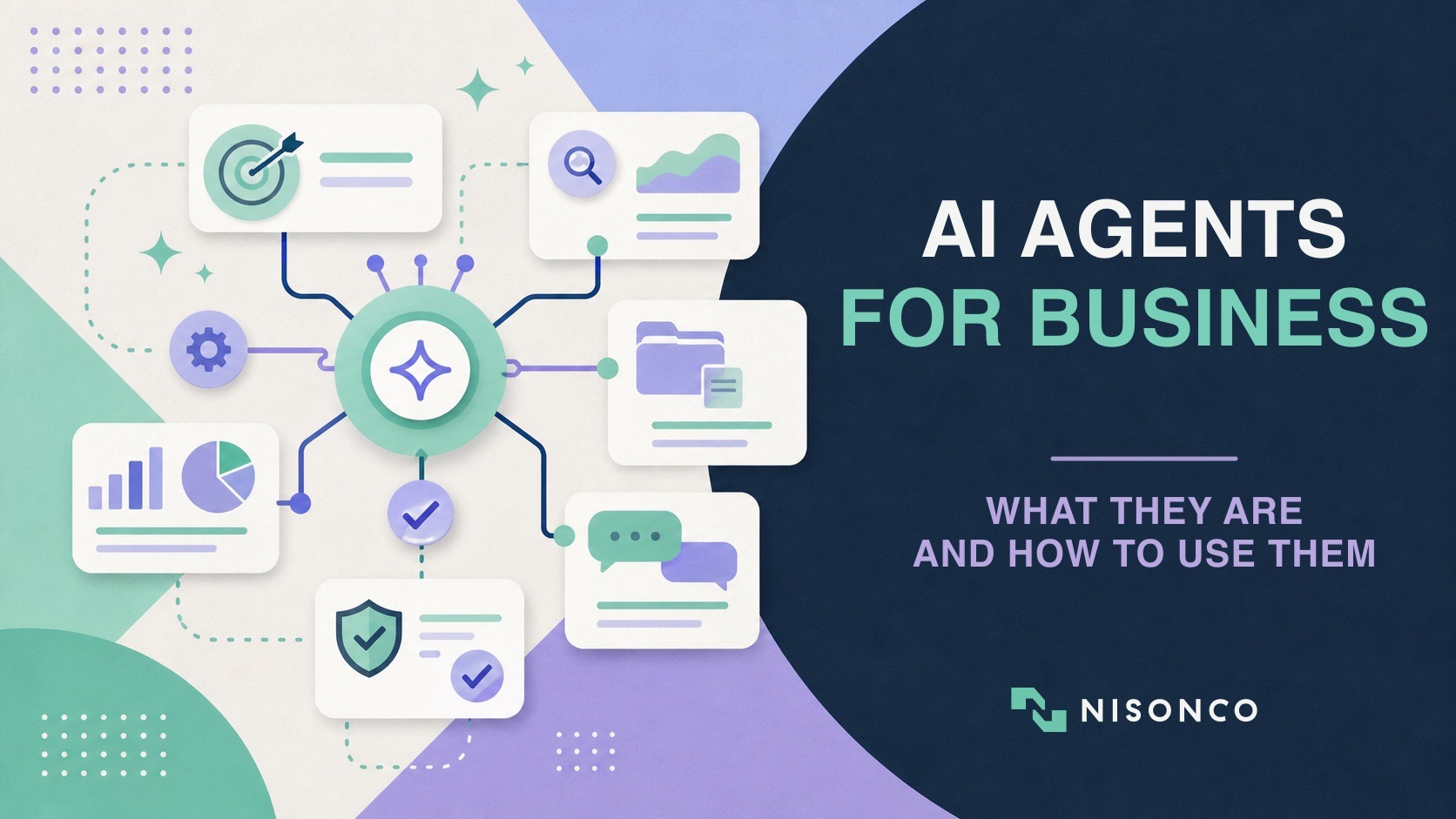
An AI agent is software that can perceive context, receive or set a goal, plan a sequence of steps to reach that goal, and then take actions across digital tools and systems until the task is complete or a human needs to intervene. Gartner defines AI agents as autonomous or semi-autonomous entities that perceive, decide, and act in pursuit of goals, which separates them clearly from tools that simply generate text or follow a fixed script on demand.
Think of the practical difference this way. A chatbot answers a question. An AI agent reads the question, determines what needs to happen next, pulls relevant data from your CRM or knowledge base, takes the allowed action, logs the interaction, and flags a follow-up task for your team, all without a person orchestrating each individual step. That multi-step, goal-directed behavior is what makes agentic AI a different class of tool.
This is not a future capability. OpenAI has released agent tooling that combines model reasoning with tool use, web search, and structured outputs to take real actions. Anthropic has introduced computer use capabilities that allow agents to navigate software interfaces much the way a person would, including legacy systems that lack a modern API. The infrastructure for practical agentic AI is here and accelerating across major platforms.
How AI Agents Differ from Chatbots and Simple Automations
Understanding what AI agents are for business means understanding what they are not. Most organizations already use two categories of AI-adjacent tools: conversational chatbots and rule-based automations. Agents are fundamentally different from both, and the distinction matters before you spend a dollar on implementation.
A chatbot is trained to respond to inputs. It can answer FAQs, retrieve a policy, or walk a user through a form. The moment an interaction requires judgment, a new data source, or a decision the chatbot was not pre-programmed for, it either fails or escalates. It does not plan. It reacts to what is directly in front of it.
Rule-based automation, including robotic process automation (RPA), operates differently but shares the same fundamental limitation. RPA tools are excellent at following fixed scripts: move this file, update that record, send this notification when X condition is met. The moment a process deviates from the expected path, the script breaks. There is no reasoning layer capable of adapting.
AI agents sit in a different category because they combine a reasoning layer with tool access and memory. They can interpret ambiguous goals, break them into steps, adjust mid-task when something unexpected happens, and coordinate across multiple systems simultaneously. Gartner expects most enterprises to shift from assistive AI tools toward outcome-focused, orchestrated agentic workflows by 2028, which reflects how rapidly the expectations around AI in business operations are evolving.
Four Realistic AI Agent Use Cases for Business
The most grounded question any business owner can ask is: what would an AI agent actually do in my operation? Here are four high-leverage areas where agentic AI is delivering practical value right now, with an honest assessment of what each requires to work well.
Customer Service Triage
Agents can handle password resets, order status checks, return requests, and warranty inquiries without a human touching the ticket. They pull relevant account data, apply your policy rules, take the permitted action, and close the loop. When a case falls outside those parameters, they escalate with full context preserved so your team can pick up without starting over. Klarna reported in early 2024 that its AI assistant handled approximately two-thirds of customer service chats in its first month, though these are company-reported figures from a specific operational context and should inspire experimentation, not set expectations for every business.
Lead Follow-Up and Qualification
An AI agent integrated with your CRM can enrich incoming leads, score them against your defined criteria, draft personalized follow-up messages using approved templates, and book meetings directly onto your sales team’s calendar. It does not replace your sales team. It eliminates the manual processing that slows them down so they can focus their time on conversations that genuinely require a person. Salesforce’s Agentforce platform is one example of how these capabilities are now accessible within existing CRM stacks, which substantially lowers the barrier to a first deployment.
Research and Market Intelligence
Research agents can scan web sources, synthesize findings, extract competitor positioning, and produce cited briefs for your team’s review. OpenAI’s Deep Research demonstrates how an agent can autonomously browse, analyze, and produce structured reports with citations, a task that previously required hours of analyst time per deliverable. The practical application for sales enablement, category analysis, and strategic planning is significant.
Operations and IT Workflows
Agents can file support tickets, summarize incidents, draft resolution notes, and propose next actions for your IT or operations team. ServiceNow has introduced agentic AI innovations that include agent control towers designed to coordinate these tasks while preserving full auditability across enterprise workflows, which addresses one of the core governance concerns at scale.

Where Human Oversight Is Non-Negotiable
Here is the honest part that vendor demos often skip. AI agents are not ready to run unsupervised across every function in your business, and that is not a limitation that will fully disappear with the next model release. Some decisions carry too much risk, legal exposure, or relational complexity to delegate entirely to software.
Refund authorizations above a defined threshold, account closures, communications to high-value or sensitive accounts, any action touching protected personal data, and anything requiring genuine judgment about nuanced context all belong in human hands, at least for final approval. The practical design principle here is explicit escalation: a well-built agent should know exactly when it is operating outside its authorized scope and should hand off cleanly, with full context, to a trained team member who can take it from there.
The NIST AI Risk Management Framework provides a strong foundation for identifying where those escalation lines should be drawn and how to document and monitor AI systems over time. For any organization building agents into consequential workflows, working through that framework is not optional. It is the due diligence that separates responsible deployment from a liability.
Security is a related and equally serious concern. Agents that operate across systems can be vulnerable to prompt injection and data leakage if not properly hardened. The OWASP Top 10 for Large Language Model Applications outlines specific risks and mitigations relevant to agentic systems, and any serious deployment should work through that list before going live. If a vendor is not familiar with it, that tells you something important.
The Risk Every Business Leader Should Know
Gartner has named a dynamic worth understanding before you evaluate any vendor in this space: “agent washing.” It describes what happens when a vendor relabels an existing chatbot, a basic workflow tool, or an RPA script as an AI agent without the substantive capability to back up the claim. Gartner predicts that over 40 percent of agentic AI projects will be canceled by end of 2027, largely due to unclear value, unmanaged costs, and governance gaps that emerge when organizations buy into the marketing before scoping the actual use case.
When evaluating any agent solution, the questions that cut through the noise are these: Does it plan, or does it just react? Does it use real tools to take real actions, or does it generate text that describes actions? What happens when it encounters something outside its design parameters? What do the audit logs look like, and who can access them? A vendor with genuine capability can answer all of these questions clearly and specifically.
Gartner also forecasts that an average Fortune 500 company could operate more than 150,000 agents by 2028, up from fewer than 15 today. Without centralized governance from the start, that scale creates operational complexity that can undermine the very efficiency gains you deployed agents to achieve. Governance is not a phase two problem. It is a day one design requirement.

A Practical Framework for Getting Started
The organizations getting real value from AI agents for business operations are not the ones that launched the biggest, most ambitious programs. They are the ones that started narrow, defined success in measurable terms, and expanded only after proving the model worked in a controlled environment. That pattern holds whether you are a ten-person professional services firm or a large enterprise.
A practical starting framework looks like this:
– Define the agent’s scope before anything else. What goal is it pursuing? What tools and data can it access? What is explicitly off-limits? What triggers an escalation to a human? Write these down as a runbook before deployment.
– Choose a pilot use case with clear, measurable metrics. Customer service containment rate, lead response time, research brief turnaround, or ticket resolution speed are all concrete measures you can baseline before the pilot and track after. Pick one metric. Run a limited pilot. Measure against it.
– Design the escalation protocol before you go live. Your team should know exactly how to receive a handoff from the agent, with full context, so they can continue without friction or lost information.
– Centralize oversight from the first deployment. Maintain a single place where you can see what your agents are doing, audit their decisions, adjust their scope, and revoke permissions if needed. This becomes critical as complexity grows.
– Expand based on evidence, not momentum. Once a pilot hits its target metrics over a sustained period, that is the signal to expand scope or introduce a second use case. Not before.
McKinsey estimates generative AI’s potential annual value across business use cases at $2.6 trillion to $4.4 trillion, but their analysis also makes clear that most AI value comes from disciplined integration into proven operational levers, not from deploying the newest technology for its own sake. That framing is worth keeping in front of any internal stakeholder who is tempted to skip the pilot and scale immediately.
If you want a starting point for understanding how AI-driven systems currently see your business before you invest in agent infrastructure, our free AI Search Rankings tool gives you a quick read on your AI search visibility, which is increasingly connected to how well your operation is documented and discoverable across digital systems. Our other free AI tools are a practical next step for businesses that want to see and improve how AI systems read and reference their site.
Your Managed AI Operations Partner
Here is a reality most business owners face. Understanding what AI agents are for business operations is one thing. Having the internal bandwidth to scope, build, govern, and continuously improve them is another challenge entirely. Most organizations do not have a dedicated AI operations function, and building one from scratch is expensive and slow in a market that is moving quickly.
That is where NisonCo comes in. We work with businesses across industries as a managed AI operations partner, effectively serving as your AI department. We identify the use cases with the highest leverage for your specific operation, design the agent architecture and guardrails, integrate with your existing stack, establish the KPIs that will tell you whether it is working, and maintain ongoing oversight so your agents perform within scope over time.
This sits alongside our SEO services for competitive and regulated industries and our broader AI consulting practice, which means we bring an integrated perspective on how your AI operations connect to your search visibility, content strategy, and lead generation. For businesses in professional services, our professional services SEO team works alongside our AI practice to make sure your operational improvements are reflected in how you appear to the clients who are searching for you right now.
We are not here to sell you a tool and disappear. We build and run these systems with you, with clear KPIs and structured reporting, so you always know what is working and what to adjust next.
The Bottom Line on AI Agents for Business
AI agents for business represent a real and meaningful shift in what software can do on your behalf. They are not chatbots with better branding. They are not the automation tools you have been running for years. They plan, act, coordinate across systems, and hand off to humans when genuine judgment is required. The business case is grounded in real capability, not projection.
The organizations that build durable operational advantages from agentic AI will be the ones that start with narrow, well-governed pilots, measure results honestly, and scale with discipline. That approach is less exciting than the demos suggest and far more effective than the hype would have you believe.
If you are ready to move from understanding AI agents to actually deploying them in your operation, we would be glad to walk through your specific situation and identify where the best opportunities are. Contact NisonCo to start the conversation and get a clear picture of what managed AI operations can realistically do for your business.