
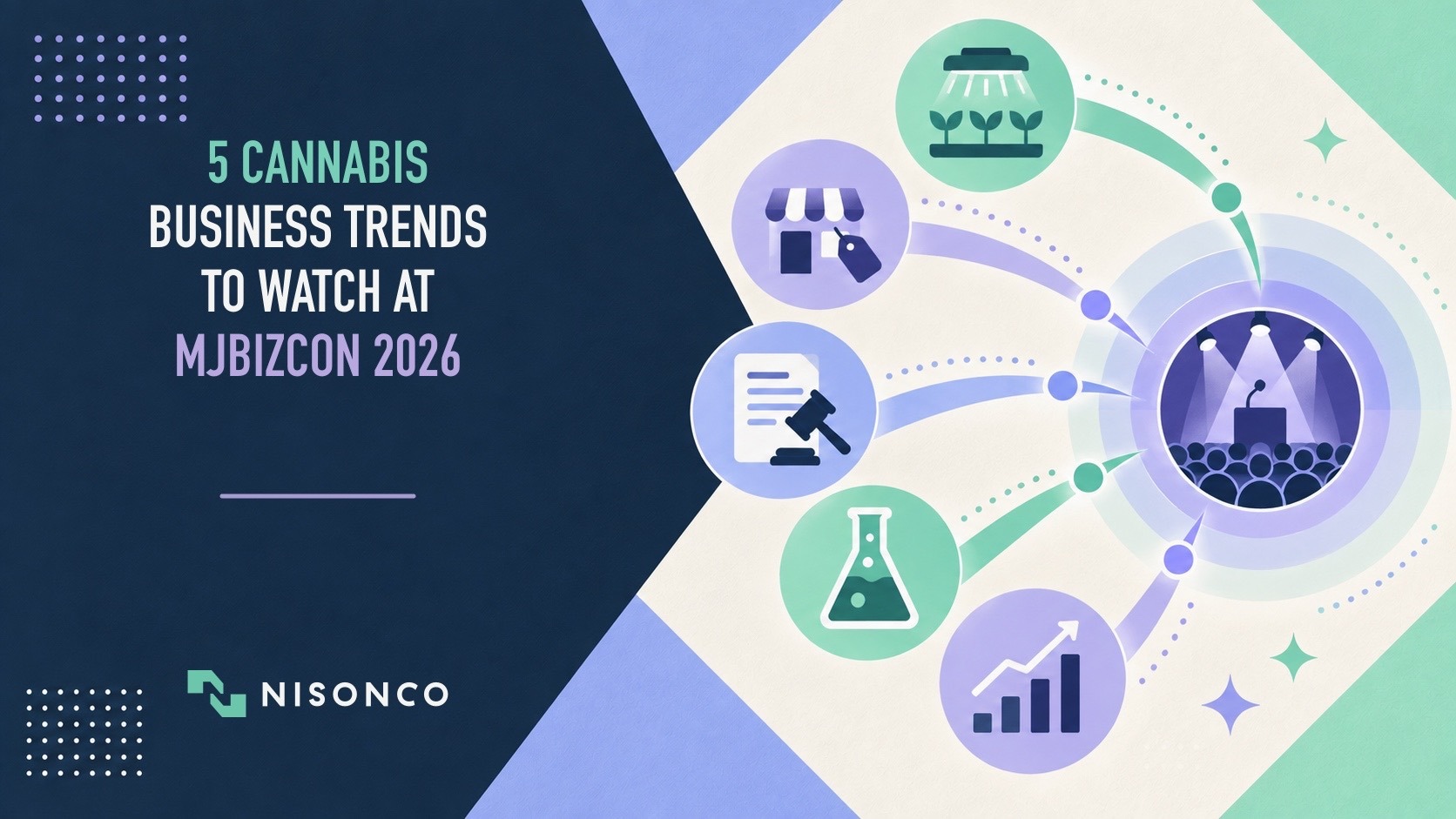
The MJBizCon 2026 agenda is not a forecast. It is a useful map of the questions cannabis operators, investors, researchers, and marketers expect to debate when the industry meets in Las Vegas from December 1 through 4.
This year, the official program puts federal scheduling, capital and liquidity, AI accountability, retail staffing, and clinical development on the same agenda. That combination says more than a generic list of predictions. It shows where businesses are trying to separate opportunity from operational reality.
Here are five trends to investigate at MJBizCon 2026, along with the questions to ask before changing a budget or strategy.
If you are building the rest of the week around those questions, NisonCo's MJBizCon attendee guide covers meeting preparation, on-site planning, and follow-up.
Quick Takeaways
- Treat the conference agenda as a signal map, not proof that a prediction will come true.
- Federal scheduling questions remain specific and legally complex. Verify the current rule and product category before acting.
- Capital conversations are shifting toward valuation, exits, and disciplined deployment, not growth at any price.
- AI claims need baselines, implementation costs, and measurable operating outcomes.
- Retail staffing and clinical commercialization deserve attention because both connect operational execution to revenue.
1. Federal Scheduling Questions Are Becoming Operating Questions
The current MJBizCon schedule includes sessions on what Schedule III could change for operators, investors, taxes, banking, DEA oversight, and FDA compliance. The topic belongs on the agenda, but broad statements about "rescheduling" can hide important distinctions.
The federal record is product- and process-specific. The DEA's current marijuana regulatory-actions page lists final action for defined medical-product categories while also documenting a formal process around the proposed broader transfer of marijuana to Schedule III. That means businesses should not assume every tax, banking, advertising, or compliance consequence has already changed in the same way.
At the conference, ask:
- Which exact federal rule or product category does this claim address?
- Is the speaker describing a final rule, a proposal, an expected effect, or a state-level practice?
- What changes now, what may change later, and what remains prohibited?
- Which decisions require legal, tax, or regulatory counsel before implementation?
For marketers, the practical lesson is restraint. A federal headline does not automatically authorize a new health claim, paid-media tactic, or national campaign. Build messaging around what is verified today and keep a correction path ready for changing rules.
This article is not legal or tax advice. Verify any material decision with qualified counsel and the current government record.
2. Capital Strategy Is Focusing on Liquidity, Valuation, and Exits
MJBizCon added an Investment and Liquidity Summit for 2026. The official program emphasizes M&A case studies, valuation, exits, capital deployment, and the consolidation reshaping the sector.
The agenda does not prove that funding will become easier or that deal volume will rise. It does show that owners and investors want more concrete conversations about how value is created, measured, and realized.
Useful questions for founders and executives include:
- What evidence supports the valuation method being discussed?
- Which assets create defensible value: licenses, distribution, intellectual property, retail footprint, brand demand, data, or operating performance?
- What integration work follows an acquisition, and who pays for it?
- What would make the company more credible to a buyer or investor six months from now?
Marketing leaders have a role in this conversation. Search visibility, media credibility, customer retention, brand demand, and clear category positioning do not replace financial performance. They can, however, make a company easier to understand and evaluate.
The mistake is treating visibility as a vanity layer. The better question is whether an investor, partner, or acquirer can quickly see what the company does, where its authority comes from, and how its claims are supported.
3. AI Buyers Are Asking for Proof of Return, Not Another Demo
One official 2026 session focuses on separating real return from vendor hype in AI for cultivation. Its description highlights compliance reporting, environmental optimization, demand forecasting, implementation risk, data readiness, and vendor accountability.
That scrutiny should extend beyond the grow. Cannabis teams are buying AI for research, content, sales support, customer service, forecasting, compliance work, and internal operations. A polished demonstration can show possibility. It does not show what the tool will cost to operate inside a real company.
Before buying or expanding an AI system, ask:
- What baseline process is the tool replacing or improving?
- Which data must be clean, available, and permitted for the system to work?
- What does a successful output look like, and who decides whether it is acceptable?
- How often does a person need to correct, verify, or redo the result?
- What is the total cost per usable outcome, including review and implementation?
- What happens when the system is wrong, unavailable, or connected to stale information?
This is especially important in regulated work. Faster output is not useful if it creates unsupported product claims, privacy problems, or inaccurate compliance guidance.
A more useful standard is simple: identify the task, preserve the inputs and outputs, measure correction burden, and judge the tool on accepted results rather than impressive first drafts.
For a plain-English overview of the underlying technology and the controls longer tasks require, read NisonCo's guide to AI agents for business.
Marketing teams evaluating these systems can also use NisonCo's AI marketing services as a starting point for connecting tool tests to measurable business work.
4. Frontline Retention Is Being Treated as a Revenue Issue
The retail track includes a session connecting employee retention, onboarding, product knowledge, and training with dispensary conversion and margins.
That framing matters because staffing is often discussed as a separate human-resources problem. In retail, the customer experiences the business through the people answering questions, explaining products, and creating a consistent visit.
At MJBizCon, retail leaders should ask:
- Which behaviors actually improve customer confidence and basket quality?
- How does the company measure the cost of turnover beyond recruiting expense?
- Which product and compliance knowledge should every employee have?
- How quickly can a new employee become useful without being rushed into unsupported advice?
- What information from the sales floor should reach marketing, merchandising, and leadership?
For marketing teams, frontline language is valuable evidence. Repeated customer questions can improve website copy, educational content, search strategy, and staff resources. The goal is not to turn employees into scripts. It is to make sure the language a brand publishes reflects the questions people actually ask.
5. Medical Cannabis Is Moving Deeper Into Clinical and Commercial Questions
The 2026 program includes a pharmaceutical and clinical research track. Current sessions address cannabinoid drug pipelines, FDA pathways, clinical trials, manufacturing scale, pricing, payer access, physician education, and patient needs. The FDA's cannabis research and drug-approval overview is an important primary reference for separating approved-drug pathways from broader cannabis marketing claims.
This is a different conversation from marketing a state-licensed adult-use product. Drug development and medical education involve different evidence standards, claims, audiences, and regulatory pathways.
Companies working near this space should ask:
- What stage of evidence supports the claim?
- Is the discussion about a research finding, a state medical program, or an FDA-reviewed product pathway?
- Who is qualified to communicate the information to patients, clinicians, investors, or the public?
- What evidence must exist before the claim appears in marketing or media materials?
- Which manufacturing, reimbursement, and education barriers remain after a positive trial result?
The communications opportunity is not to make the strongest possible claim. It is to make the most precise claim the evidence supports and help each audience understand what the result does and does not mean.
How to Use These Trends at MJBizCon
Choose one question from each trend that matters to your company. Use it to select sessions, request meetings, and take notes.
For a structured approach to prospecting, meetings, and follow-up, use NisonCo's conference lead generation checklist.
For every major claim you hear, capture:
- who made the claim;
- what evidence they cited;
- the population, product, or market it applies to;
- the implementation requirements;
- the measurable outcome;
- the limitation or open question.
That process turns a conference theme into a working research brief. It also protects your team from treating a memorable panel quote as a universal business rule.
Turn Market Signals Into a Clearer Visibility Plan
MJBizCon will surface more ideas than any team can act on. The useful work begins when you decide which claims deserve verification, which changes affect your customers, and which story your company is qualified to tell.
For companies that need their verified expertise to remain visible after the conference, NisonCo's cannabis SEO services connect those questions to durable search content.