
AI ROI starts with a business result the company can trace to the project. Software, setup, training, review, maintenance and risk all count toward the cost.
More businesses are trying AI, but many still struggle to turn it into useful day-to-day work. The U.S. Census Bureau found that overall business AI use hovered between 17% and 20% from December 2025 through May 2026. Among adopting firms, sales and marketing was the most common AI-enabled function. The Census data shows adoption is real, but adoption alone says nothing about whether an investment is working.
The same gap appears in small and midsize businesses. The OECD’s 2026 survey of more than 2,000 SMEs found rapid growth in off-the-shelf AI use, yet few businesses had connected those tools to day-to-day work in a consistent, secure way. Time constraints, maintenance costs and skills gaps continued to limit results.
Start with one workflow and its current numbers, not a software demo.
Quick Takeaways
— Measure the work, not the tool. Choose one business process, record its current performance and compare the AI-assisted version against that baseline.
— Count the complete cost. Licenses are only one expense. Include setup, data preparation, integration, training, human review, maintenance and risk controls.
— Time saved is not automatically cash saved. Value appears when returned capacity reduces spending, increases useful output or allows employees to perform higher-value work.
— Quality belongs in the ROI calculation. Faster output is not valuable when corrections, customer confusion or compliance risk rise with it.
— Scale only when the results hold up. A small 90-day test gives leadership better information than a company-wide rollout based on enthusiasm.
What Does AI ROI Mean?
Return on investment compares the financial benefit produced by an initiative with its complete cost.
AI ROI = (financial benefit created − total AI cost) ÷ total AI cost × 100
If tracked results show that an AI workflow created $30,000 in annual value and it costs $12,000 to build and operate, its simple ROI is 150%. The investment returned its cost plus an additional $18,000 in measured benefit.
The formula is simple. Choosing honest inputs takes more care.
Financial benefit may include verified labor savings, incremental contribution margin, avoided outside spending, reduced rework or loss prevention.
Total cost should include the work required to make the system useful and safe, not only the monthly subscription.
The measurement period should be long enough to include implementation and adoption. A one-week test may reveal whether a workflow functions, but it rarely proves sustainable annual value.
ROI should also sit beside payback period. A project can have an attractive long-term return yet take too long to recover its initial cost for a cash-constrained business.
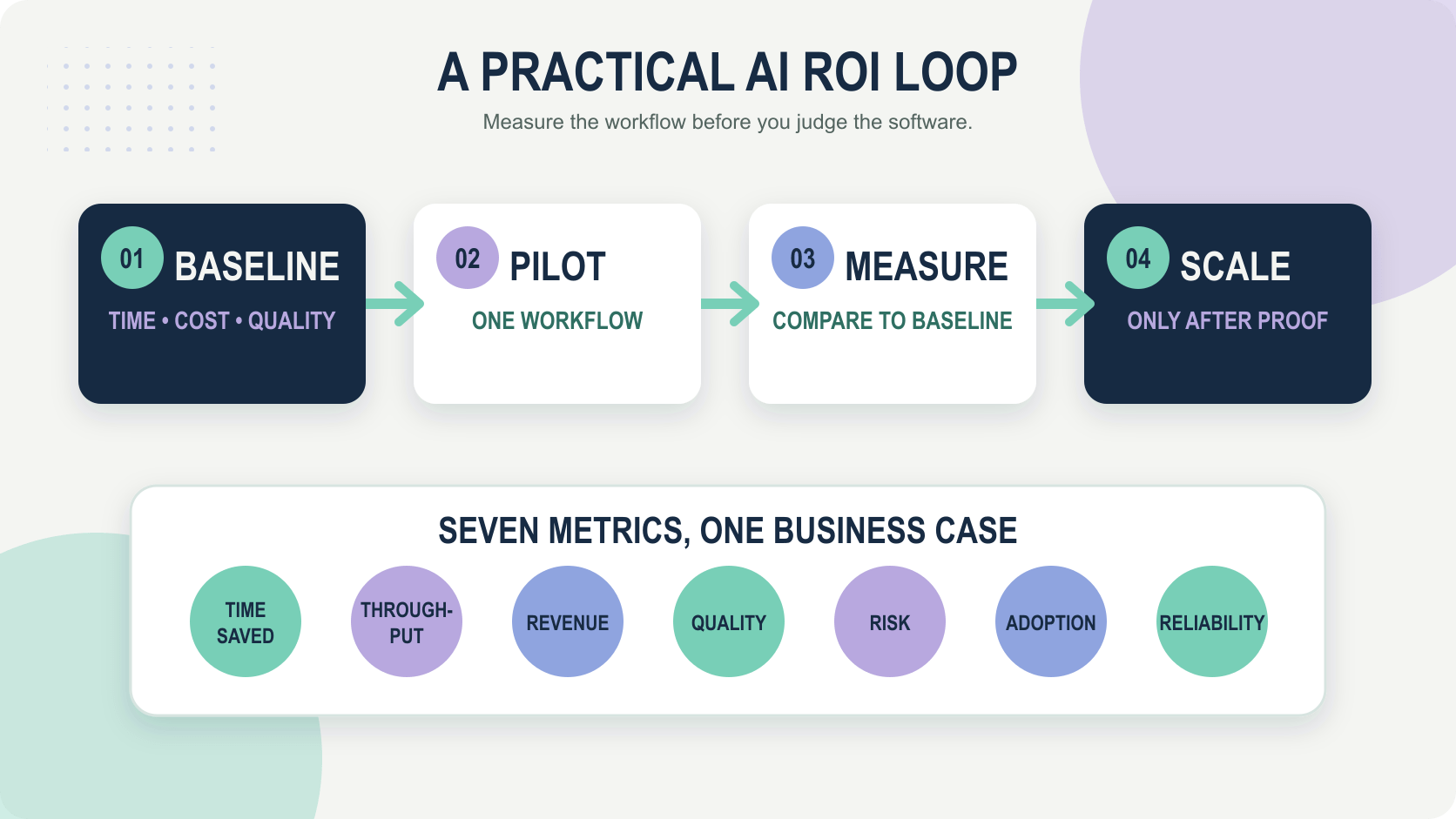
Seven Metrics That Show Whether AI Is Working
Useful Time Returned
Measure the minutes required before and after AI, then adjust for review and correction time. Translate that capacity into dollars only when the business can explain how it will be used.
Throughput and Capacity
Track qualified leads researched, tickets resolved, reports completed or deliverables produced per employee. More output matters only when quality remains acceptable.
Incremental Revenue or Margin
Measure additional conversions, retained customers or sales capacity against a fair comparison. Contribution margin is usually more useful than gross revenue.
Cycle Time
Track how long a business process takes from request to completion: lead response, proposal preparation, research, onboarding or customer support.
Quality and Rework
Measure factual errors, rejected outputs, correction time, customer satisfaction and escalation rates. A speed gain that increases rework may be negative ROI.
Avoided Cost and Risk
Count reduced contractor spending, fewer missed opportunities, earlier issue detection or lower exposure—but use conservative probabilities for losses that did not occur.
Adoption and Reliability
Track intended users, successful runs, fallback frequency and system availability. These are enabling metrics: a workflow creates no value when employees abandon it.
Choose the metrics to fit the job. An AI marketing agent may be judged on research time, qualified opportunities and approval-ready output. An internal knowledge assistant may be judged on resolution time, answer accuracy and employee adoption. A customer-facing system needs stronger quality, escalation and risk measures.
Costs to Include in the ROI Denominator
Businesses often overstate AI ROI because they count a subscription while ignoring the work required around it. At minimum, the denominator should include software and usage, implementation, data preparation, employee adoption, human review and ongoing ownership.
— Build and operating costs include licenses, API usage, integrations, storage, monitoring and initial configuration.
— People costs include process mapping, data cleanup, training, documentation, review and correction time.
— Ownership and risk costs include maintenance, vendor changes, security review, quality evaluation and incident response.
The NIST Generative AI Risk Management Profile calls for governance, evaluation and monitoring throughout an AI system’s life. Those controls cost money. Skipping them can lead to errors, poor adoption or avoidable risk.
This article uses those costs only as inputs to the ROI equation. For detailed budget ranges and implementation paths, use NisonCo’s dedicated guide to AI implementation cost for a small business.
A Simple AI ROI Example
Consider a lead-research workflow completed by two employees.
| Measure | Before AI | After AI | Annual Value or Cost |
|---|---|---|---|
| Weekly research labor | 30 hours | 12 hours including review | 18 hours returned × $35 × 50 weeks = $31,500 |
| Qualified leads | 270 per week | 400 per week | Capacity gain measured separately from labor savings |
| Software and API usage | $0 | $350 per month | $4,200 cost |
| Initial setup and testing | $0 | One-time project | $8,000 cost |
| Maintenance and review | Included above | 3 hours per month | $1,260 cost |
Using labor value alone, first-year benefit is $31,500 and first-year cost is $13,460. The simple first-year ROI is approximately 134%.
Do not automatically add the value of higher lead volume unless the business can measure downstream conversion and contribution margin without double-counting the same benefit. Conservative math is more useful than an impressive projection nobody trusts.
NisonCo has a real version of this story. In a case study, Zapier documented how NisonCo increased weekly lead generation by 48%, from approximately 270 to nearly 400 leads, while reducing research and operational expense by an estimated $30,000 annually. The value came from a narrow, measured workflow—not from buying AI in the abstract.
Baseline, Pilot and Payback Review
Establish the Baseline
Choose one workflow and record its current time, volume, quality, cost and failure rate. Decide in advance what result would justify continuing, changing or ending the test.
Run a Controlled Pilot
Introduce AI to one small part of the process and record review time, unsuccessful runs and corrections, not just successful demonstrations. Let the intended employees use it under normal conditions so you can see whether people use it and whether it works consistently.
Review ROI and Payback
Calculate benefit, complete cost, payback period and quality impact. Mark every input as measured, estimated or unknown, then scale only if the business case survives that review. For the implementation sequence itself, follow NisonCo’s first 90-day guide to using AI in business.
A successful pilot answers one question: did this workflow create enough value to justify the next step?
Common AI ROI Mistakes
Counting all time saved as profit. If employees save five hours but their output, staffing or higher-value work does not change, the business has gained capacity—not yet cash.
Using model benchmarks as business outcomes. A model’s performance on a technical evaluation does not establish customer satisfaction, operating savings or revenue in your workflow.
Ignoring the comparison. Sales, demand, staffing and seasonality may change during a pilot. Without a baseline, normal business movement can be mistaken for AI impact.
Double-counting benefits. Faster work and reduced labor cost may describe the same economic value. Higher lead volume and higher revenue may also overlap.
Leaving quality outside the formula. Corrections, rework and customer harm are costs even when they appear in another department.
Continuing because the demonstration was impressive. A pilot should have a stopping rule. Ending a weak project early is a return on disciplined decision-making.
Frequently Asked Questions About AI ROI
What is a good ROI for an AI project?
There is no universal threshold. Compare the return, payback period, risk and management burden with other investments available to the business. A modest reliable return may be better than a larger projection built on uncertain adoption.
How long does it take to measure AI ROI?
A contained workflow can often produce useful evidence in 60 to 90 days. Projects with long sales cycles, complex integrations or seasonal outcomes require a longer measurement period.
How do you value employee time saved by AI?
Multiply verified net time returned by an appropriate loaded labor rate, then explain how that capacity creates value. Subtract review and correction time. Do not present all saved time as cash unless spending actually declines.
Should revenue be the main AI metric?
Revenue is important when the workflow directly affects acquisition, retention or sales capacity. Internal projects may be better measured through cost, cycle time, quality, risk and employee capacity.
Can a small business calculate AI ROI without a data team?
Yes. Begin with a spreadsheet, a consistent baseline and a small number of measures the company already understands. Measurement discipline matters more than a complicated dashboard.
Build an AI Business Case You Can Verify
The best AI ROI analysis is usually plain. It names the workflow, uses conservative assumptions, counts hidden costs and gives leadership a clear yes, no or not-yet decision.
NisonCo helps businesses identify worthwhile AI opportunities, establish baselines, run small tests and measure what happens in day-to-day work.
Measure AI Before You Scale It
Build an AI roadmap around measurable results, tools people will actually use and clear human review.