– The Operational Problem Teams Keep Hitting
– The Conference Lead Lifecycle at a Glance
– Conference Marketing Before the Event
– Conference Lead Capture During the Event
– Conference Follow-Up Emails and Workflows
– Trade Show and Conference Lead Generation Metrics
– Common Mistakes in Conference Lead Management
– Build a System That Works Every Time
Quick Takeaways
– Define your ideal customer profile and success metrics before you arrive, not after the event when momentum has faded.
– Capture structured notes on the show floor: role, fit, urgency, promised action, consent, and next step.
– Triage by urgency and fit within 24 to 48 hours of returning.
– Complete promised actions first, then follow up according to urgency: same or next business day for high-intent contacts and promptly for everyone else.
– Measure meetings held, qualified opportunities, pipeline value, and cost per qualified opportunity, not badge scan totals.
– Route partnerships, media inquiries, recruiting leads, and vendor conversations to the teams that can act on them.
The Operational Problem Teams Keep Hitting
Your team just returned from a major trade show. You scanned 200 badges, collected a stack of business cards, and had dozens of productive conversations on the floor. Three weeks later, your CRM has 47 new contacts, none of the promised follow-ups have gone out, and your sales team cannot remember which conversations were actually worth pursuing.
This is a common operational failure. Even well-resourced teams struggle to connect event activity to measurable outcomes when notes are inconsistent, ownership is unclear, and CRM handoffs happen days later.
The fix is not a better badge scanner or a fancier booth. It is a repeatable before, during, and after workflow that transforms event participation into qualified pipeline. This conference lead generation checklist is that workflow, built for B2B founders, marketers, sales leaders, business-development teams, exhibitors, and sponsors who need a system they can run the same way at every event they attend.
The Conference Lead Lifecycle at a Glance
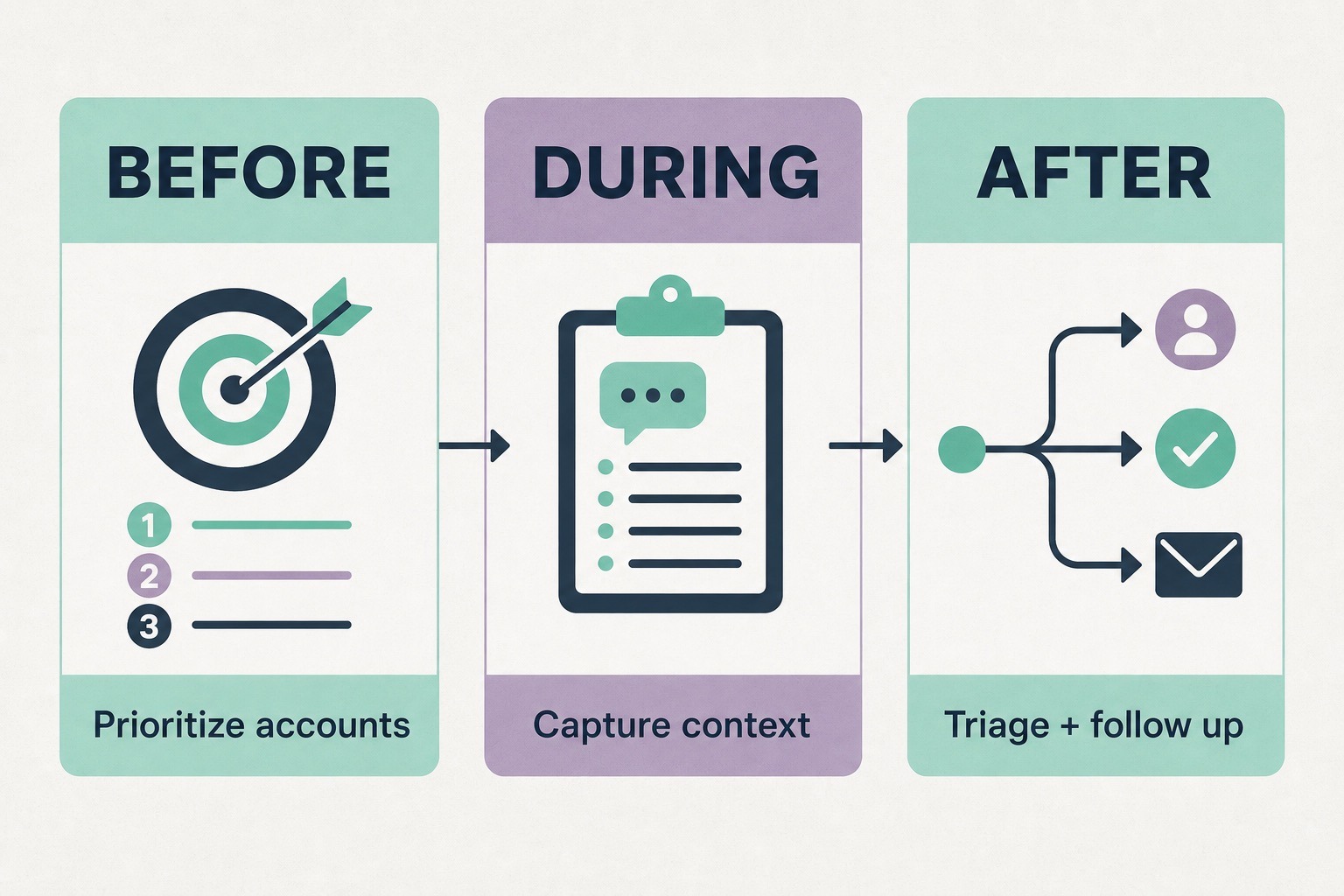
Before thinking about any individual tactic, it helps to see the whole motion. Conference lead generation is not a single-day activity. It is a three-phase revenue cycle, and what you do in each phase determines whether the investment pays off.
Before: Define goals and your ideal customer profile, clean and prioritize the target list, assign account owners, prepare talking points, and book meetings in advance.
During: Capture concise structured notes for every meaningful interaction, qualify in real time, record consent, and avoid collecting data you do not need.
After: Triage by urgency and fit, honor commitments, update the CRM, run an accountable follow-up cadence, and route non-sales outcomes to the right teams.
Experienced revenue teams treat the event as the middle of the story, not the end. The quality of the preparation and follow-through determines whether a good conversation becomes an opportunity.
Conference Marketing Before the Event
Define Your ICP and Success Metrics
The most important work in your pre-conference marketing plan happens before you leave the office. Start by being explicit about who you need to meet: which roles, which industries, which account tiers, and what buying signals make someone worth a real conversation versus a quick hello.
Define success in revenue-aligned terms before anyone boards a flight. How many qualified meetings do you need to hold? How many new opportunities should this event contribute to your pipeline? What would make the event worthwhile even if a deal does not close immediately? Agreeing on those definitions before the event keeps marketing and sales aligned on what a good conference looks like in numbers.
Clean the List and Research Prospects
Get the attendee list or exhibitor directory as early as the organizer releases it. Enrich key accounts with current contact details and note which existing customers or open opportunities will be present at the event. Conferences are not only net-new prospecting opportunities. They are also useful moments to strengthen customer relationships, advance open opportunities, and meet partners in person.
Remove names that are clearly outside your ICP before you start tiering. A clean, prioritized list makes every decision on the show floor faster and more consistent across your entire team.
Prioritize Accounts and Assign Owners
Map target accounts by tier: must-meet, high-value, and exploratory. Pre-book meetings wherever the calendar allows. Give each priority account a named owner and a designated backup in case the primary contact is occupied during the target window. Scheduled meetings create clearer intent and shared context, while leaving room for valuable conversations that happen organically on the floor.
NisonCo’s free Conference Prospect Prioritizer helps you score and sort your target list before you arrive, so your whole team hits the floor with a consistent, data-informed view of who to pursue first and why.
Prepare Talk Tracks and Small Asks
For each account tier, prepare two or three relevance-first talk tracks that reflect the specific problems those buyers face. Avoid generic company overviews. The goal of a first conference conversation is not to close; it is to earn a specific, small next step: a diagnostic call, a short demo, or a document you commit to sending.
A specific, low-friction next step is easier for both sides to evaluate than an oversized commitment. Know what your team can reasonably offer at the end of a conversation, and align everyone on those next steps before the event.
Conference Lead Capture During the Event
What to Record for Every Interaction
Badge scans and business cards are contact starts, not qualified leads. A useful record gives the follow-up team enough context to act without reconstructing the conversation from memory.
For every meaningful interaction on the show floor, record these seven fields:
Who: name, role, and buying influence within the organization
Fit: ideal-customer-profile match and the relevant use case discussed
Urgency: timeline and any trigger or deadline mentioned
Problem: the specific business issue named in the conversation
Promised action: what your team committed to send or do
Consent: preferred contact method and applicable marketing permission
Next step: a concrete who, when, and what
These seven fields are your minimum viable notes. Anything less and your follow-up team is guessing. Anything more and you risk collecting data you have no practical reason to store.
Build the Seven Notes Into Your Capture Process
The seven prompts above should live directly in the lead form, shared note template, or CRM handoff your team already uses. They are not seven separate reports. They are the minimum context another person needs to understand the conversation and take the promised next step.
Keep the capture experience short enough to complete immediately after the conversation. Use plain field names such as role, fit, timing, problem, promise, consent, and next step. Require a source or note for any qualification judgment, and avoid collecting information that has no clear follow-up purpose.
A Note on Data and Consent
Privacy and marketing rules vary by location and audience. Collect only what you need to follow up appropriately, document consent and communication preferences where required, honor opt-out requests, and avoid storing sensitive personal information in conference notes. Where GDPR applies, the European Commission’s data-minimization guidance says personal data should be adequate, relevant, and limited to what is necessary for the stated purpose. Have qualified counsel review your process when your outreach spans multiple jurisdictions.
Conference Follow-Up Emails and Workflows
Triage by Urgency and Fit Within 24 to 48 Hours
The moment your team returns from the event is when context is freshest and promised actions are easiest to honor. Complete urgent commitments and high-intent follow-up the same or next business day. Process the remaining records within 24 to 48 hours so useful details do not disappear into inboxes and notebooks.
Route accounts already in-process to their owners for immediate action. Hot prospects who named a specific problem and agreed to a next step go to the front of the sales follow-up sequence for events. Lower-fit or longer-timeline contacts move into a slower nurture track so they do not block your highest-value pipeline from moving forward.
Update the CRM Completely Before You Follow Up
Every meaningful contact needs a complete CRM record before the first follow-up message goes out. Assign an owner, record the event source, map the important note fields, and schedule the next task. The same discipline applies across any CRM platform. Without complete records, accountability disappears and pipeline reporting becomes difficult to trust.
Manual handoffs are especially vulnerable to delays and missing context. Automate what you can, and set a firm internal deadline for entries that cannot be automated so follow-up begins while conversations are still fresh.
Build a Relevant, Accountable Follow-Up Cadence
Match your message to the conversation you actually had. If you promised a case study, send the case study. If the contact named a specific pain point, reference it directly in your subject line. Generic conference follow-up emails that could have been sent to anyone register as noise and undermine the trust you built on the floor.
Use multi-step sequences that vary by persona and urgency: a personal first email, a LinkedIn connection with a note, and a short voicemail where appropriate. Every step in the sequence needs an assigned owner and a due date. If you want to accelerate your first-touch drafts while keeping human judgment in the process, NisonCo’s free Conference Lead Triage and Follow-Up Planner can help turn your structured notes into relevant, timely outreach without replacing the review step that keeps messages on-target.
How Custom AI Tools Can Support Conference Prep and Follow-Up
A custom AI workflow can reduce the administrative work around a conference without turning outreach into an unsupervised mass-send. The useful automation begins before the event and continues through CRM cleanup, follow-up drafting, and reporting.
Before the event: A tool can research an approved exhibitor, speaker, sponsor, or attendee list; compare accounts with your ideal customer profile; identify relevant triggers; prepare account briefs; and draft personalized meeting requests for human review.
During lead capture: A structured form can turn short conversation notes into consistent CRM fields, flag missing context, identify the promised action, and route sales, partnership, recruiting, vendor, or media conversations to the correct owner.
After the event: An AI-assisted workflow can deduplicate records, validate company details against approved sources, prepare follow-up drafts, schedule internal tasks, and assemble a pipeline report. Deterministic code should handle exact matching, required-field checks, dates, permissions, and CRM writes; AI is better used for research, classification, and first-pass language.
NisonCo can help design a lightweight internal workflow or a fully integrated custom tool around your conference process, CRM, data sources, and approval rules. Our custom AI software development services focus on useful automation with clear human checkpoints, especially before any message is sent or customer record is changed.
Route Non-Sales Outcomes to the Right Teams
Not every strong conference conversation belongs in the sales queue. Partnerships belong with business development. Media inquiries belong with your communications team. Potential candidates belong with recruiting. Vendor introductions belong with procurement. Build a deliberate routing step into your post-event workflow so that value does not quietly die in the wrong person’s inbox, waiting for someone to figure out what to do with it.
Trade Show and Conference Lead Generation Metrics
Badge scan totals are not a success metric. They measure presence, not progress. If you want to know how to measure event ROI in a way that connects to revenue, these are the metrics that matter:
Meetings held: pre-booked and on-site, not just badge touches
Qualified opportunities created: tracked by pipeline stage
Commitment completion rate: assets sent, introductions made, and demos scheduled as promised
Speed to first follow-up: measured from handoff to first relevant outreach
Pipeline value: new opportunities created and existing deals influenced
Conversion rate: event contacts that become qualified opportunities
Cost per qualified opportunity: total event spend divided by qualified opportunities created
Report these metrics through four lenses: volume, conversion, velocity, and value. That gives leadership a clearer view of outcomes tied to revenue instead of activity that fills a spreadsheet without showing whether the investment worked.
The teams winning on conference ROI are not necessarily those with the biggest event budgets. They are the ones measuring the right things from the start and holding the process accountable throughout the full cycle.
Common Mistakes in Conference Lead Management
Measuring Success by Badge Scans Alone
Raw scan volume tells you how many contacts were captured, not how many qualified conversations occurred. IAEE and the Center for Exhibition Industry Research recommend focusing on lead quality over quantity and evaluating event performance both in real time and after the show. Set targets for qualified conversations and meetings before the event starts, then compare those goals with the results during the debrief.
Manual, Delayed Lead Hand-Offs
Manual lead transfers create delays, data errors, and accountability gaps that compound across every event in the calendar. Automate the handoff wherever possible, and set a firm internal deadline for entries that cannot be automated.
Generic, Slow Follow-Up That Could Have Been Sent to Anyone
Following up five to seven days after an event with a templated email that references nothing from your actual conversation signals that the interaction did not matter. Build a timed, accountable sales follow-up sequence for events before you leave for the conference so the process is ready to execute the moment you land back home. Speed and relevance together are required. Neither alone is sufficient.
Over-Collecting Data You Do Not Need
Collect only the information required to follow up appropriately and move the relationship forward. Storing data you never use creates unnecessary risk and muddies your CRM records over time. Avoid recording sensitive personal information unless your organization has a specific, documented need and an approved process for handling it.
Frequently Asked Questions
Are badge scans considered leads?
Not by themselves. A badge scan is a contact start. Add context (fit, problem named, next step) and assign an owner, and you have something actionable. Without those elements, a scan is just a name and a company with no clear path forward and no accountable next move.
How quickly should we follow up after a conference?
Match speed to intent and commitments. Complete promised actions and contact high-intent prospects the same or next business day, then process the remaining records within 24 to 48 hours. Build the workflow before the conference so your team is not deciding how to follow up after returning.
What should we report to leadership after an event?
Revenue-aligned metrics: meetings held, qualified opportunities created, pipeline value, conversion rate, velocity, and cost per qualified opportunity. Map these to a shared framework so leadership sees outcomes that connect to revenue goals, not raw activity counts that obscure whether the investment made sense.
Can we email contacts we met at a conference without explicit consent?
Meeting someone at an event does not automatically create blanket permission for every kind of marketing. In the United States, the FTC’s CAN-SPAM compliance guide explains that commercial-email requirements also apply to business-to-business messages, including accurate sender information and a working opt-out method. Record the context of the conversation, use the contact method they expect, identify your organization clearly, honor opt-out requests, and follow the laws that apply to the recipient’s location. Seek legal guidance for a definitive compliance policy.
What is a good conversion rate for trade show leads?
This varies significantly by industry, deal size, and how strictly your team defines a qualified opportunity. The more useful question is whether your event conversion rate is improving over time as you refine your ICP definition, follow-up process, and pre-event preparation. Track your baseline at every event and use it to make better decisions about where to invest next.
Build a System That Works Every Time
A conference is not a lead generation event on its own. It is a lead generation opportunity that only becomes qualified pipeline when you treat it as a continuous revenue motion: disciplined before you arrive, structured while you are on the floor, and accountable the moment you return home.
The teams that consistently convert event participation into measurable pipeline are not the ones with the largest booths or the most aggressive badge-scanning strategies. They are the ones running the same repeatable conference lead generation checklist at every event, with clear owners, defined metrics, and a follow-up process that was ready to execute before the conference even started.
If you are mapping out your event calendar and work in the cannabis or hemp space, NisonCo’s 2026 global hemp and cannabis conference guide is a practical resource for identifying the events worth prioritizing this year. For teams in the cannabis and psychedelic verticals who want deeper sector-specific event lead generation strategy, our cannabis event lead generation guide covers the nuances of that market in detail.
If you want expert support building or running a conference lead generation program from end to end, NisonCo offers outbound conference lead generation services designed to help your team convert event conversations into pipeline you can measure, report, and grow from.
Ready to build a conference lead system that actually works? Contact NisonCo to talk through your event strategy and goals.