– What Is AI Knowledge Management?
– Why AI Knowledge Management Systems Fail
– AI Knowledge Management Architecture: Data, Retrieval, and Permissions
– How to Build an AI Knowledge Management System
– AI Knowledge Management Use Cases by Industry
– Privacy, Security, and Business Data Governance
– AI Knowledge Management Tools vs Custom Development
Quick Takeaways
– An AI second brain is a permission-aware knowledge system, not a chatbot placed on top of a folder.
– Start with a narrow business decision or workflow, an authoritative source map, and a measurable baseline.
– Retrieval, permissions, source quality, model behavior, workflow design, ownership, and adoption all affect whether the system succeeds.
– Require cited answers, explicit uncertainty, freshness rules, permission tests, and a repeatable evaluation set before broad rollout.
– Use deterministic code for access control, filtering, calculations, validation, and workflow rules; use AI where language and judgment add value.
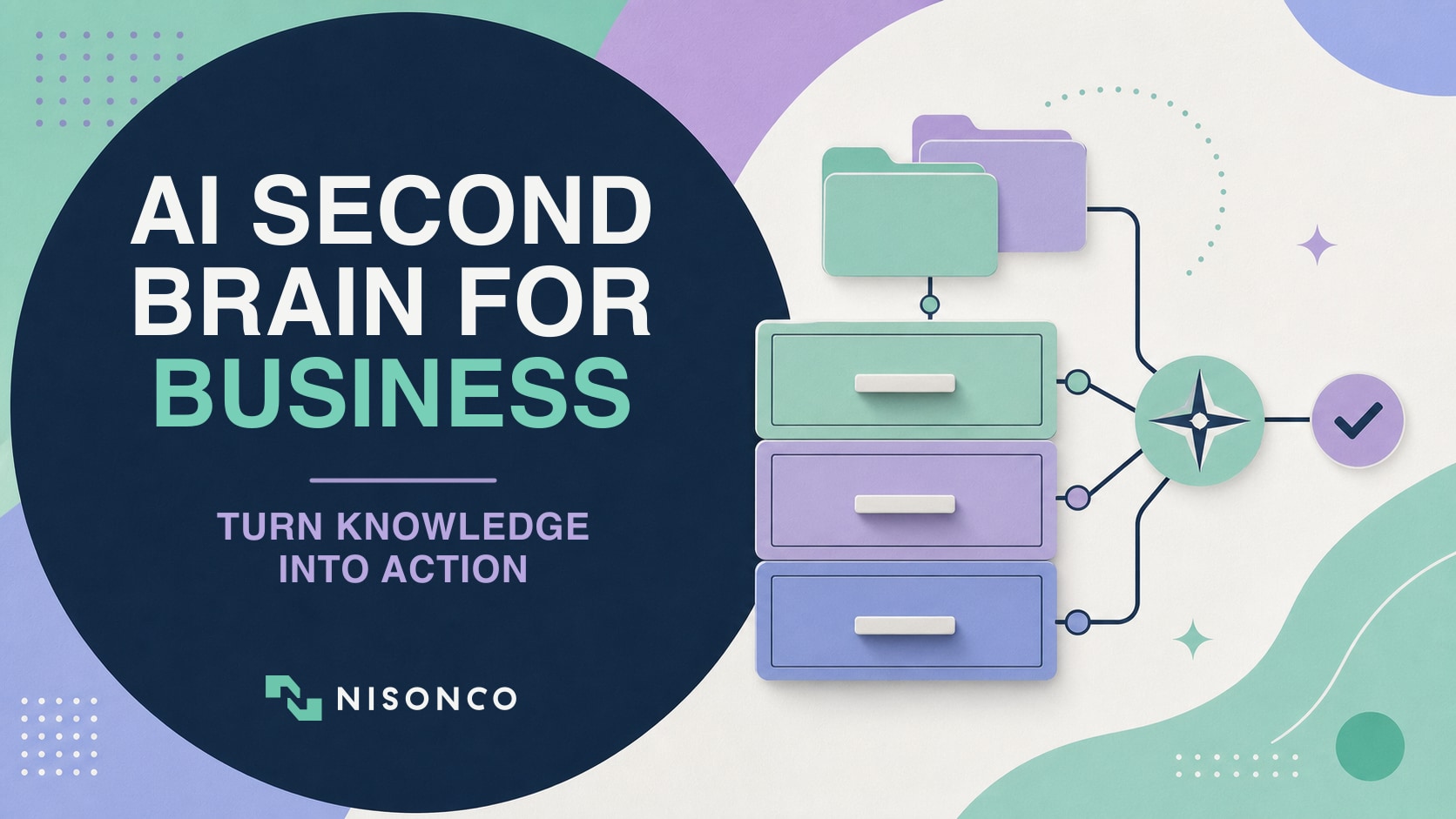
AI knowledge management turns approved business data into answers and workflows that employees can inspect, verify, and use. A business “second brain” is one way to describe the experience, but the underlying system is broader. It includes structured and unstructured data, source ownership, permissions, synchronization, indexing, retrieval, citations, evaluations, interfaces, monitoring, and human review.
The goal is not to pour every company file into a chatbot. It is to help an authorized employee find the current answer, see the supporting evidence, and complete a defined task without exposing information they should not see.
What Is AI Knowledge Management?
A personal second brain helps one person capture and retrieve notes, research, and ideas. A business second brain extends the concept across shared systems and roles. It may connect approved documents, websites, CRM records, tickets, product data, policies, and other sources, then answer questions or support workflows based on what each user is allowed to access.
Many systems use retrieval-augmented generation, or RAG. Instead of relying only on what a model learned during training, the application retrieves relevant material from approved sources at request time and supplies that evidence to the model. The foundational RAG research describes this retrieval-plus-generation pattern.
In a production business system, RAG is only one layer. The implementation also needs to decide which sources are authoritative, synchronize changes, carry access-control metadata, rank evidence, handle conflicts, cite sources, refuse unsupported answers, record evaluations, and route high-risk outputs to a person.
How AI Turns Business Data Into Usable Knowledge
Data management and knowledge management are related, but they are not the same job. Data management controls how information is collected, structured, classified, stored, synchronized, retained, and deleted. Knowledge management controls how people find, understand, validate, and apply that information. An AI knowledge system depends on both.
Structured business data includes records with defined fields, such as products, customers, tickets, transactions, inventory, and CRM opportunities. Unstructured data includes documents, email, call transcripts, slide decks, policies, web pages, and free-form notes. Each source needs an owner, sensitivity level, update method, authoritative status, and access rule before an AI system can use it reliably.
The system then converts data into usable knowledge through a controlled sequence. Connectors read approved sources. Synchronization keeps the index current. Metadata records ownership, sensitivity, dates, client or matter boundaries, and authority. Retrieval selects evidence the user is permitted to see. The model explains or synthesizes that evidence. Citations and audit logs let a person verify what happened.
This is why an AI data management project cannot be reduced to choosing a model or vector database. If the product catalog is inconsistent, permissions are too broad, policies have no owners, or deleted records remain in an index, the answer layer will reproduce those defects in more persuasive language.
Policy library
Authority: Operations owner; approved versions outrank drafts
Access: Internal; role-based exceptions for HR or legal policies
Refresh or deletion: Refresh after approval; remove superseded versions from retrieval
CRM records
Authority: Revenue operations; CRM is the system of record
Access: Client and account-team access only
Refresh or deletion: Near-real-time synchronization; honor record deletion and reassignment
Product data
Authority: Product or ecommerce owner; governed fields are authoritative
Access: Broad internal access, with restrictions for embargoed products
Refresh or deletion: Scheduled or event-based updates; flag missing required fields
Meeting transcripts
Authority: Meeting owner; lower authority than signed agreements or approved policy
Access: Participants and approved team roles
Refresh or deletion: Apply retention rules and remove recordings when consent or policy requires
Why AI Knowledge Management Systems Fail
There is rarely one cause. A stronger model cannot repair a missing permission design, and a perfect source library cannot help if employees do not trust or use the interface.
Poor source quality: Duplicated, stale, contradictory, or ownerless documents cause the system to retrieve weak evidence.
Weak retrieval: The right source exists, but chunking, metadata, search, ranking, or query design fails to surface it.
Unsafe permissions: The index loses document access rules, or the application filters results after retrieval rather than before it.
Unclear authority: The system treats an old draft, an informal message, and an approved policy as equally trustworthy.
Missing workflow fit: Answers appear in a separate chat while employees still need to re-enter the result in the system where work happens.
No evaluation discipline: A demo looks fluent, but nobody tests citations, stale information, permission boundaries, edge cases, or version changes.
No operating owner: Connectors break, policies change, and content ages after the launch team moves on.
The implementation plan should address all seven. Model choice matters, but it is one design decision among many.
AI Knowledge Management Architecture: Data, Retrieval, and Permissions
A practical system separates deterministic controls from probabilistic model behavior. Identity, access rules, source selection, calculations, schema validation, and consequential writes should use explicit code and policies wherever possible. The model can interpret language, synthesize evidence, draft responses, and help decide when the answer needs human judgment.
1. Approved sources
Documents, databases, websites, CRM records, tickets, and policies are cataloged
Control: Owner, authority level, classification, retention, and update frequency
2. Permission-aware ingestion
Content is normalized, tagged, indexed, and synchronized
Control: Access-control metadata, deletion handling, freshness checks, and connector monitoring
3. Identity and request policy
The system establishes the user, role, purpose, and allowed action
Control: Single sign-on, least privilege, policy checks, and audit context
4. Retrieval
Search selects relevant evidence from only the sources the user may access
Control: Permission filtering before retrieval, source priority, ranking, and minimum-evidence rules
5. Model response
The model synthesizes retrieved evidence into an answer or draft
Control: Citations, uncertainty, constrained output format, and refusal when evidence is insufficient
6. Action and review
The user accepts, edits, escalates, or triggers a downstream workflow
Control: Human approval for consequential actions and deterministic validation before writes
7. Evaluation and logging
Quality, security, usage, and system changes are measured
Control: Test set, permission cases, incident process, version record, and feedback loop
This architecture does not require every organization to build a custom application. A configured enterprise platform may supply several layers. The team still needs to verify that the platform’s connectors, permissions, citations, retention, and evaluation capabilities meet the actual requirement.
How to Build an AI Knowledge Management System
Step 1: Choose One Decision or Workflow
Do not begin with “make all company knowledge searchable.” Select a narrow use case such as answering account managers’ approved policy questions, preparing a first draft of a support response, or finding the current product specification.
Record the current baseline: time per task, wait time, error rate, escalation rate, or another measurable result. Define which outputs require review and what the system must never do. A pilot charter should identify the owner, users, approved purpose, success metric, risk level, and end date.
Deliverable: A use-case charter and KPI baseline that let the team judge whether the pilot improves real work.
Step 2: Set Data Management Requirements Before AI Indexing
For every question in scope, identify the authoritative source. If the policy manual conflicts with an old training deck, which wins? If a CRM record changes, how quickly should the index reflect it? If no approved answer exists, should the system refuse, escalate, or label the response as a draft?
A source inventory should record repository, owner, business purpose, data class, authority level, format, update method, retention, geographic constraints, and deletion process. The taxonomy should reflect how users ask questions, not just the existing folder tree.
Deliverable: A source catalog and taxonomy with named owners, authority levels, and freshness rules.
Step 3: Design Permissions and Governance Before Indexing
Map roles and access conditions before content enters a shared index. A user who cannot open a source document should not receive its contents through an AI answer. Test record-level and client-level boundaries, not only broad department roles.
Create a governance register covering approved use, prohibited use, data classification, vendor, model, retention, human review, incident owner, evaluation cadence, and change history. The NIST AI Risk Management Framework provides a useful structure for governing, mapping, measuring, and managing AI risk.
Deliverable: A permission matrix and governance register approved by source owners, security, and the business owner.
Step 4: Build Retrieval and the Role-Specific Interface
Choose connectors and indexing methods based on the source types. Structured records may need filters or database queries; documents may need parsing, chunking, hybrid keyword-and-semantic search, and metadata. Do not push every source through one generic pipeline.
The interface should match the role. A support agent may need a cited answer and response draft inside a ticket. An executive may need a concise briefing with links to the underlying records. A compliance reviewer may need the retrieved excerpts, policy version, and audit trail before approving anything.
Use deterministic code for permissions, source filters, required fields, calculations, thresholds, schema checks, and system updates. Use the model for classification, query interpretation, synthesis, and drafting when those tasks benefit from flexible language understanding.
Deliverable: A role-specific pilot interface connected to approved sources, with permission-aware retrieval and visible citations.
Step 5: Evaluate Answers, Permissions, and Freshness
Build the evaluation set before the pilot expands. Include common questions, difficult questions, ambiguous wording, missing answers, stale documents, conflicting sources, long documents, adversarial instructions, and users who should receive different answers because of permissions.
Measure more than whether an answer sounds good. Check whether the correct source was retrieved, the citation supports the claim, the answer reflects the current policy, restricted content remained restricted, uncertainty was communicated, and the required review occurred. Re-run the set after model, prompt, connector, index, or permission changes.
Deliverable: A versioned evaluation set, permission test suite, freshness tests, acceptance thresholds, and remediation log.
Step 6: Roll Out With Ownership and Feedback
Train users on what the system knows, how to inspect evidence, when to escalate, and how to report a bad answer. Instrument the workflow so feedback reaches an owner with enough context to reproduce the problem.
Assign owners for the application, each source, access policy, model and prompt configuration, security review, and user support. Define a decommissioning path. A knowledge system that has lost its owner should not continue producing authoritative-sounding answers indefinitely.
Deliverable: An operating plan with ownership, training, monitoring, incident response, maintenance cadence, budget, and retirement criteria.
AI Knowledge Management Use Cases by Industry
The examples below are design patterns, not claims that NisonCo has deployed each system for a client. They show how the same architecture changes with industry sources, permissions, and risk.
Agencies and Professional Services
An agency knowledge system could help an account team find approved messaging, contract scope, past deliverables, and current performance context. Client-level permissions are essential: a person assigned to Client A should not retrieve Client B’s strategy. The interface might draft a status update, but a human should verify numbers, commitments, and confidential context before sending.
Cannabis, CBD, and Psychedelic Organizations
Regulated-market teams may need to reconcile product data, state rules, marketing restrictions, approved claims, and internal review history. Sources and requirements change, so freshness and jurisdiction metadata matter as much as model quality. An answer should identify its jurisdiction, effective date, and source rather than presenting a generic rule. NisonCo’s work across cannabis SEO, CBD SEO, and psychedelic SEO provides context for the communications and search challenges in these categories; legal conclusions still require qualified counsel.
Nonprofits
A nonprofit could use a permission-aware knowledge system to help staff locate program procedures, grant requirements, board policies, donor restrictions, or approved impact language. The design should separate public program information from donor records, personnel data, and confidential case material. Our overview of AI consulting for nonprofits discusses how constrained teams can approach adoption without treating every task as an automation target.
Ecommerce and Product Teams
An ecommerce system could unify product specifications, inventory policy, merchandising guidance, support articles, and returns rules. Structured product facts should come from the system of record; the model can explain or format them, but should not invent missing specifications. If the answer triggers a refund, product update, or customer message, deterministic validation and an approval boundary become part of the product.
Privacy, Security, and Business Data Governance
Vendor training commitments are relevant, but they are only one control. Procurement should also review product tier, contract, retention, subprocessors, residency, encryption, identity, audit, administrative visibility, connector behavior, feedback handling, and incident response.
OpenAI says that, by default, it does not use inputs or outputs from ChatGPT Business, Enterprise, Edu, or the API to train or improve its models. Review the current OpenAI business data commitments and the terms for the exact product and configuration.
Anthropic says that, by default, it does not use inputs or outputs from commercial products such as Claude for Work and the API to train its models, with exceptions for explicit feedback or opt-in. Review Anthropic’s current commercial model-training explanation. Consumer product rules can differ from commercial rules.
Microsoft says prompts, responses, and Microsoft Graph data used by Microsoft 365 Copilot are not used to train foundation models, and that Copilot respects the user’s existing permissions. The specific controls vary by subscription and configuration; see Microsoft’s enterprise data protection documentation.
Google says Workspace customer data is not used to train or improve the generative AI and language models that power systems outside Workspace without permission. Google also documents admin and content-owner controls over what Gemini can access. Review the Google Workspace generative AI privacy commitments and verify the protections of the exact Workspace edition.
These commitments reduce specific risks; they do not make every upload appropriate. A system can still reveal over-shared documents to an authorized-but-unintended user, preserve stale copies, follow malicious instructions embedded in a source, or generate an incorrect synthesis. Reduce risk through contracts, data minimization, configuration, permission cleanup, source controls, testing, monitoring, and human review.
AI Knowledge Management Tools vs Custom Development
Use an off-the-shelf second brain or configured enterprise platform when its connectors, permissions, citations, administration, and evaluation features satisfy the use case. Custom software becomes reasonable when specialized sources, access logic, workflows, evidence requirements, or interfaces cannot be handled reliably without additional engineering.
A custom build offers control but creates a product to operate. It requires connector maintenance, model and prompt versioning, evaluations, logging, security review, user support, and a budget for ongoing changes. Our companion guide, Second Brain App vs. Custom AI Knowledge Base, provides the detailed decision rubric; this article is the implementation guide.
Build the Smallest System That Can Earn Trust
The goal is not to centralize every file or make an AI answer every question. It is to improve a defined workflow with authoritative evidence, correct permissions, measurable quality, and clear ownership. Start with one use case, prove that employees can inspect and trust the answer, and expand only when the evaluation data supports it.
If your requirements point beyond a configured platform, NisonCo’s custom AI software development services can help map sources and permissions, design a pilot, and build the evaluation and governance layers around it. Contact NisonCo to discuss a practical first use case.