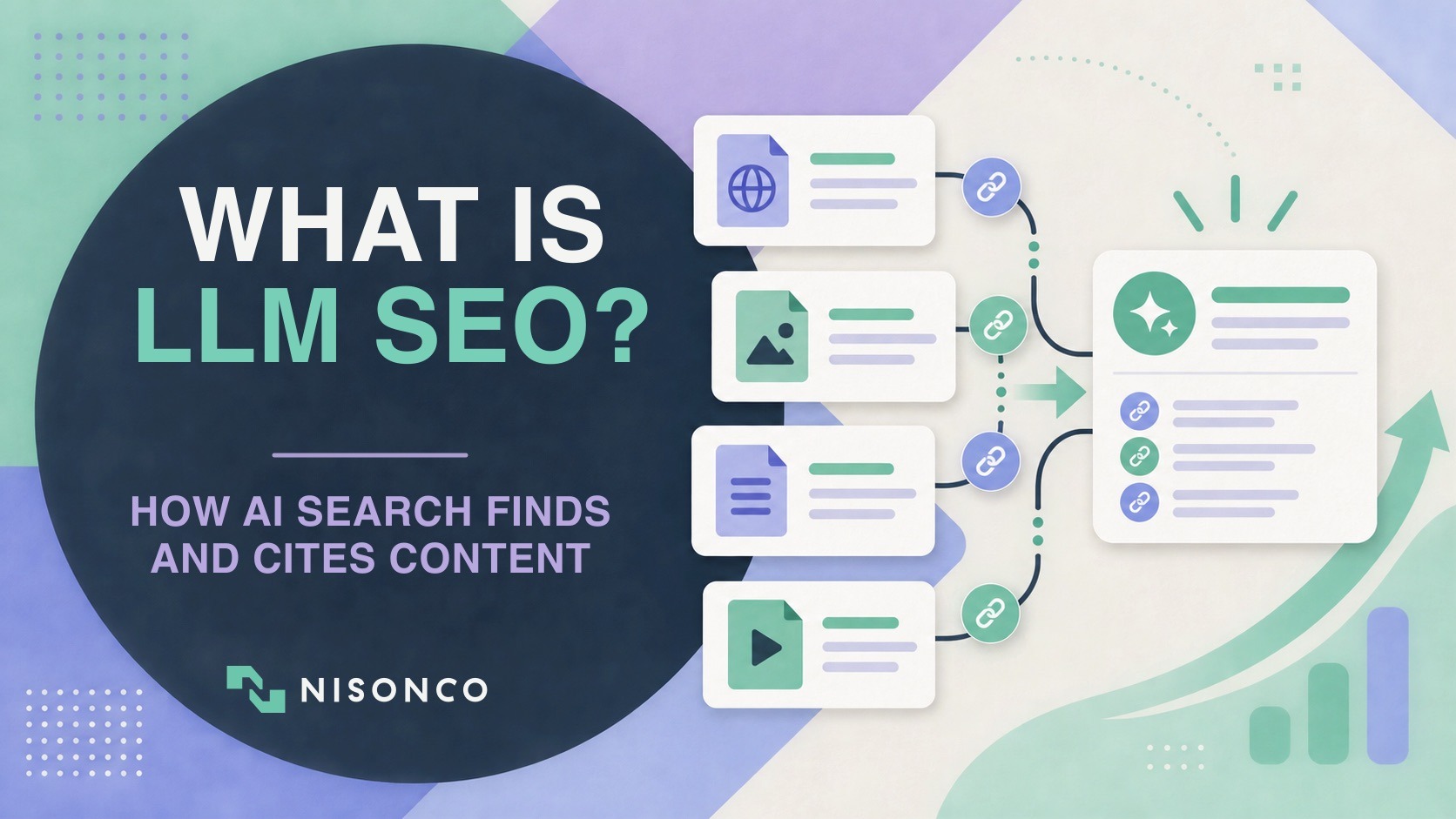
LLM SEO is the practice of structuring your content so large language models (LLMs) powering AI search experiences can retrieve, quote, and attribute it in synthesized answers. The goal is not a ranked list position but a liftable, self-contained passage an AI assistant can cite with a link. Three gates stand between your content and that citation: crawler access to your pages, surfacing for the underlying query, and the presence of a clean, quotable passage on the page itself.
What LLM SEO Means (and How It Differs From Traditional SEO)
Traditional SEO targets a ranked list. You optimize a page to appear among the top results for a keyword, and the user clicks through to read it. LLM SEO optimization targets something different: the synthesized answer an AI engine generates in response to a question, along with the source links it attributes inside that answer.
That shift changes what success looks like. In traditional SEO, the unit of value is a page. In LLM SEO, it is a passage: a one-to-three sentence answer or definition that an AI can lift verbatim, credit to your domain, and include in its response. A page that ranks well but contains no clean, answerable passages is poorly positioned for AI citation.
LLM SEO overlaps with related terms you may encounter: SEO for LLMs, generative engine optimization (GEO), and AI answer engine optimization. GEO, specifically, is the full strategy of earning citations and visibility across AI search surfaces, including Google AI Overviews and AI Mode, Perplexity, and ChatGPT Search. LLM SEO refers to the underlying content and technical practices that make retrieval possible.
The scale of this shift matters. Google holds roughly 90% of global search engine market share, so changes to how Google’s AI surfaces select and display sources carry outsized impact. At the same time, Pew Research reported in June 2026 that 49% of U.S. adults now use AI chatbots, up from a third (33%) in 2024. AI search behavior is no longer a fringe pattern.
How Large Language Models Choose Which Sources to Cite
AI-powered search engines like Perplexity and ChatGPT Search use a technique called retrieval-augmented generation (RAG). RAG-based systems pull relevant passages from external sources during query processing to ground their responses, rather than generating answers purely from what the model learned during training. A widely cited 2023 survey on RAG published on arXiv identifies this approach as the dominant method for reducing hallucination and improving source attribution in LLM-based answers.
In practice, three gates stand between your content and an AI citation:
- – Gate one (crawler access): The AI system’s retrieval crawler must be able to reach and read your pages. If your robots.txt blocks the relevant crawler, your content is invisible to that system.
- – Gate two (surfacing): Your content must appear in the retrieval pool for the specific query being processed. This depends on how well your content matches the semantic intent of the question, not just the keywords.
- – Gate three (liftability): Your page must contain a clean, self-contained passage the model can quote and justify with a link. Long, meandering paragraphs without topic-focused structure rarely pass this gate.
Miss any one of these gates and you are unlikely to be cited, regardless of how strong your broader SEO footprint is. Google has noted that links inside AI Overviews can receive more clicks than the same pages would as traditional web listings for the same query, which raises the stakes for clearing all three gates consistently.
SEO for LLMs: The Technical Prerequisites
Before content quality matters, technical access matters. AI retrieval crawlers need to reach and render your pages without obstruction.
Server-rendered HTML: Google’s JavaScript SEO guidance confirms that heavy client-side rendering introduces latency and indexing risk. Core content should be present in the initial HTML response so crawlers do not need to execute scripts to find it.
Deliberate AI crawler controls: Different AI systems send different crawlers, and you need a conscious policy for each. OpenAI publishes separate bot tokens for ChatGPT Search retrieval (OAI-SearchBot) and model training (GPTBot). Allowing one does not allow the other. Anthropic’s ClaudeBot, Common Crawl’s CCBot, and Google-Extended for Gemini training each have their own tokens. Manage these via robots.txt. A misconfigured robots.txt file can accidentally block AI answer crawlers while allowing training crawlers, or the reverse.
Semantic HTML and heading hierarchy: Use clear, logical headings (H1, H2, H3) and well-structured sections. This helps retrieval systems identify which passage answers which question, which is a prerequisite for liftability.
Structured data: Organization schema and other supported types help AI systems and Google understand who you are and what you offer. Structured data is not required for AI Overviews, but it strengthens entity resolution across systems.
Page speed and mobile rendering: Pages that load quickly and display cleanly on mobile are more likely to be fully crawled and to satisfy users who click through from AI answers. Core Web Vitals remain a practical benchmark for performance.
A note on llms.txt: llms.txt is a proposed convention (not a standard) for a Markdown file at /llms.txt that summarizes your most important pages for AI agents. It is not an access-control file; robots.txt governs access. Google has stated it does not use llms.txt for generative AI in Search. If you choose to publish one for other AI ecosystems, treat it as optional documentation. Our free llms.txt generator can help you build one quickly if you decide to explore it.
LLM SEO Optimization: Content Structures That Get Retrieved
Technical access gets your pages into the retrieval pool. Content structure determines whether a specific passage gets cited.
Answer-first paragraphs under question-style H2s: Start each section with a one-to-three sentence direct answer, then expand with supporting detail. Google’s featured snippets guidance consistently points to concise, self-contained answers as the pattern most likely to be extracted. AI retrieval systems follow a similar logic: a bounded, answerable passage is easier to lift and attribute than one buried inside a long paragraph of context.
Explicit definitions: Definitional pages should state the definition clearly near the top of the page. “LLM SEO is…” beats a three-paragraph build-up that eventually reaches the answer. This is the most reliable pattern for earning citations on informational queries.
Evidence attached to claims: AI engines favor sources that can be verified. Cite primary data, official documentation, or published research directly on the page, placed near the claim it supports. Both Google and Microsoft frame AI citations as a trust mechanism for users, so anchorable evidence strengthens your position.
Consistent entity naming: Refer to your company, products, and services consistently across headings, opening sentences, structured data, and your About and Contact pages. This helps retrieval systems resolve who you are. An AI assistant that is uncertain about your entity is less likely to cite you with confidence.
Topical authority signals: AI retrieval systems, like traditional search, tend to favor sources with broad, accurate coverage of a topic. Publishing a cluster of well-structured, evidence-backed content across your core subjects builds retrieval position over time. This is one of the most durable investments in LLM SEO optimization available to brands right now.
E-E-A-T (Experience, Expertise, Authoritativeness, and Trustworthiness) describes the criteria Google’s human quality raters use to evaluate whether a page deserves to rank. It is rater guidance, not a direct ranking factor. Pages that satisfy E-E-A-T criteria tend to meet the content quality bar that both Google’s systems and AI retrieval systems reward, which is why it matters for this work even though it operates indirectly.
How to Tell Whether Your LLM SEO Is Working
Measurement for LLM SEO requires deliberate setup. AI referrals do not always pass clean referrer data, so default analytics views will undercount this traffic channel. Our breakdown of how AI search optimization tools increase organic traffic explains where the gains from this work tend to show up, including later branded search.
Prompt-level checking: Build a monthly set of queries your customers actually ask and run them in ChatGPT, Perplexity, Google AI Overviews, and Microsoft Copilot Search. Note whether your brand, domain, or specific content is cited, and whether the AI describes your business accurately. This is manual but gives direct signal that no analytics tool can replicate. To speed up those checks, our guide to free LLM SEO tools walks through a sequenced diagnostic, from AI mentions to page answerability and credibility.
AI referral channel in analytics: Set up a custom channel group in GA4 that captures known AI referrer domains. Pair this with Search Console’s generative AI performance report, which shows how often your content appears in AI experiences. Microsoft’s Bing Webmaster Tools now includes AI Visibility Insights covering intents, topics, and citation share across Copilot experiences.
Entity accuracy as a signal: If AI assistants describe your business inaccurately or not at all, that is a signal to strengthen your entity clarity through consistent naming, Organization structured data, and well-structured About content. Accurate, consistent AI descriptions of your brand are an early indicator that retrieval is working.
No vendor can promise AI citations or a specific timeline. What you can control is whether your technical foundations are sound, your content is structured for retrieval, and your measurement is in place to detect progress. Start with what you can audit and improve today.
If you want to see where your brand currently stands across AI search surfaces, our free AI Rank Checker gives you a structured starting point. For a broader look at your organic visibility foundations, explore our SEO services, which cover the technical and content prerequisites LLM SEO builds on.
Frequently Asked Questions About LLM SEO
What is LLM SEO, and what is it sometimes called?
LLM SEO is the practice of optimizing content so large language model-powered search experiences can retrieve, cite, and attribute it in synthesized answers. It is also called SEO for LLMs, generative engine optimization (GEO), and AI answer engine optimization. GEO is the broader strategy; LLM SEO refers to the specific optimization practices that make content retrievable by LLM-based systems like Google AI Overviews, ChatGPT Search, and Perplexity.
Does traditional SEO still matter if I am optimizing for LLMs?
Yes. Technical SEO, topical authority, and quality content are foundational to both traditional search and LLM SEO. AI retrieval systems read the same crawlable, well-structured HTML that Google indexes. LLM SEO adds an emphasis on passage-level structure and consistent entity naming, but it does not replace the fundamentals. Brands that have neglected basic SEO will find it harder to earn AI citations, not easier.
What is llms.txt, and should I publish one?
llms.txt is a proposed convention, not a standard, for a Markdown file at /llms.txt that summarizes your most important pages for AI agents. It is not an access-control mechanism; robots.txt governs crawler access. Google does not use llms.txt for generative AI in Search. You may choose to publish one for other AI ecosystems as optional documentation, but it is not a primary lever for LLM SEO optimization.
How do I know if an AI search engine is describing my business accurately?
Run prompt-level checks monthly using questions your customers actually ask. Open ChatGPT, Perplexity, and Google AI Overviews and note whether your brand appears, what is said about it, and whether the descriptions match your actual offerings. Inaccurate or absent descriptions signal a need to strengthen entity clarity through consistent naming, Organization structured data, and clearly structured About content.
Can any agency guarantee AI citations or a timeline?
No. AI citation behavior reflects retrieval systems that evolve continuously, and no vendor can promise citations or a specific outcome timeline. What a qualified agency can do is improve your technical crawler access, content structure, entity clarity, and measurement setup so you are better positioned when retrieval systems select sources to cite.
If you are ready to build a structured, measurable approach to visibility in the AI search layer, our Generative Engine Optimization services cover the full strategy, from technical access and content architecture to entity clarity and ongoing measurement. We work with brands across cannabis, law, health and wellness, nonprofits, and other regulated and competitive industries where organic visibility is earned through precision, not guesswork.