
By NisonCo Staff, in collaboration with AI
We wanted to know whether paying for a more expensive Claude model would change a serious, numbers-based business decision.
So we gave Claude Sonnet 5, Opus 4.8 and Fable 5 the same fictional agency problem three times each. The agency had to choose between raising prices and risking client losses or keeping its current price and investing $40,000 in marketing.
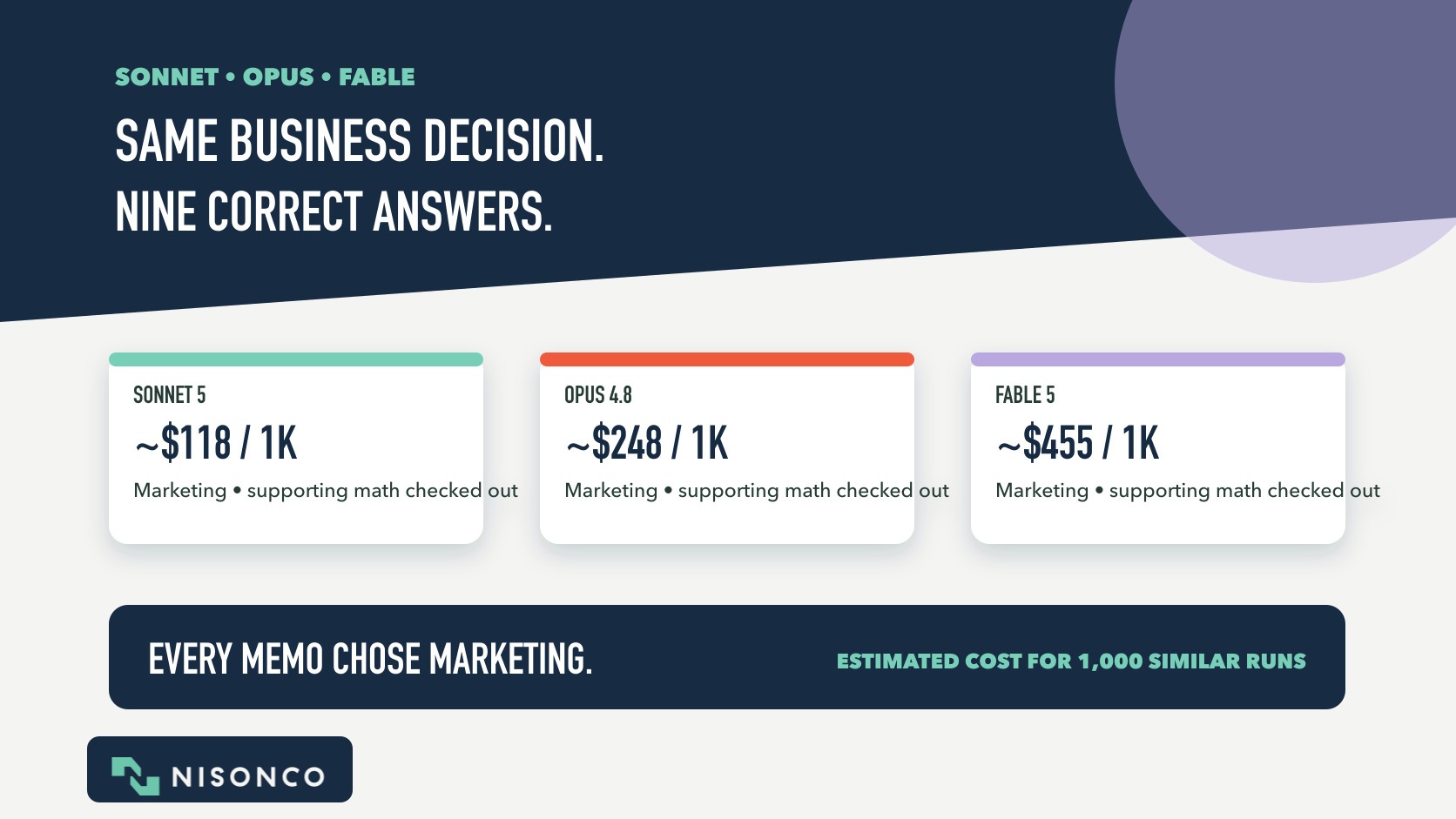
Every memo chose the marketing plan, and we found no errors in the supporting math we checked. Every answer arrived in under 90 seconds. If a business ran 1,000 similar analyses, the median estimates work out to about $118 with Sonnet, $248 with Opus and $455 with Fable.
The Short Answer
For this particular assignment, Sonnet was already capable enough. It produced the same correct work at a much lower estimated generation cost.
Why We Compared Sonnet, Opus and Fable
Anthropic's models are built for different combinations of capability, speed and workflow length. They are not simply three steps on one low-to-high ladder.
That makes the business question more useful than asking which model is “best.” We wanted to know which model was sufficient for one clearly defined job.
We chose a financial decision with a correct answer that could be checked. We used a fictional agency so every model received the same information without exposing real financial data. We repeated each model three times because a single strong response cannot show whether the result holds.
The Business Decision We Gave Each Model
The fictional agency started with 20 clients paying $4,000 per month. It had two choices.
Risk losing two clients, pay a $6,000 communication cost and slowly rebuild the client count.
Keep the $4,000 price, spend $10,000 per month for four months and add four clients on a supplied schedule.
Each memo had to calculate monthly revenue, operating profit and cash. It also had to show exactly when the recommendation would change if the price increase retained more clients or the marketing plan attracted fewer clients.
The Answer Stayed the Same. The Estimated Cost Did Not
All three models recommended marketing, and we found no errors in the supporting math we checked. The main difference was estimated cost.
These prices are estimates, not bills. We applied the Anthropic API prices recorded for the August 18 test to the token use reported by each run. The linked page may now show different rates. The per-1,000 figures simply multiply each model's median estimate by 1,000, so actual costs will change with the length of the work, token mix and current pricing. The experiment itself used an existing subscription, so it added $0 in cash spending.
Response times were much closer than costs. Every answer arrived in about 66 to 86 seconds. All three models chose the same plan, calculated the same profit totals and correctly identified the points where the recommendation could change.
What Sonnet, Opus and Fable Actually Said
We used the second completed memo from each model so the examples followed one fixed rule.
Claude Sonnet 5About $118 for 1,000 similar analyses
“Under the stated base case, Option B, hold price and invest in marketing, is recommended over Option A.”
Sonnet immediately gave the $395,000 versus $381,000 profit comparison.
Claude Opus 4.8About $248 for 1,000 similar analyses
“Adopt Option B, hold price and invest in marketing.”
Opus emphasized that the $14,000 lead was thin and execution could change the result.
Claude Fable 5About $455 for 1,000 similar analyses
“Recommend Option B, hold price and invest in marketing.”
Fable gave the same profit totals and pointed to the supplied downside cases.
The writing differed slightly, but the business answer and the math did not. Neither premium option found a different profit total, break-even point or downside result.
Did Paying More Change the Business Answer?
No.
Sonnet, Opus and Fable all recommended the marketing plan. We found no errors in the supporting math we checked in any of the nine memos.
At 1,000 similar analyses, their median estimated generation costs work out to:
– Sonnet: about $118.
– Opus: about $248.
– Fable: about $455.
Sonnet's estimate was about 52% lower than Opus's and about 74% lower than Fable's.
That does not make the models universally interchangeable. A more complex task, research, tool use or a long-running workflow could reveal differences this short memo did not.
For this assignment, however, paying more did not buy a different or more correct answer.
Fable Was Fastest but Also Most Expensive
Fable had the fastest median time at 66.22 seconds. Sonnet's median was 79.25 seconds, and Opus's was 84.66 seconds.
That made Fable about 13 seconds faster than Sonnet on a single memo. Its median estimated generation cost was also about 3.9 times higher.
For one short decision memo, saving 13 seconds is unlikely to justify that price difference by itself. At larger scale or in a longer autonomous workflow, the tradeoff could change.
That boundary matters because Fable is designed for demanding reasoning and long-running agent work. This experiment did not ask it to perform that kind of job, so the test does not tell us whether its higher price is worthwhile for its intended use case.
Which Claude Model Was Enough for This Job?
Sonnet was enough for this job.
It matched Opus and Fable on the recommendation, and we found no errors in the supporting math we checked in any Sonnet memo. It cost much less to generate and still finished in about 79 seconds by median time.
That makes Sonnet the clearest starting point for a short, structured financial memo with reliable checks.
Opus may be worth paying for when a harder task shows a real improvement. Fable may be worth paying for when the work actually needs a long-running agent. Neither extra capability changed the result here.
How We Ran and Checked the Test
We tested Claude Sonnet 5, Opus 4.8 and Fable 5 in Claude Code 2.1.220 with the medium effort setting on August 18, 2026.
Every model received the same fictional case and exact prompt. Each produced three first-pass memos without browsing, tools, follow-up instructions, retries or human corrections.
We checked every memo against a fixed answer key covering its recommendation, month-by-month values, annual totals, break-even calculations, downside cases and final answer.
GPT-5.5 reviewed the memos in a blinded order for usefulness, reasoning and communication. Fable also provided an exploratory second review, but it was one of the tested models, so we did not use its review to declare a winner. A planned separate human scorecard was not completed.
What This Test Does and Does Not Prove
This experiment shows what happened in nine runs of one fictional agency decision in Claude Code.
It does not prove that Sonnet is always equal to Opus or Fable. Three attempts per model are not enough to establish a general ranking.
The test did not cover web research, coding, tools, legal analysis, real financial advice, long-running agents or decisions with missing information. It therefore did not test the type of extended autonomous work that may justify Fable's price.
The cost figures are estimates based on reported token use and the published API prices we recorded on August 18, 2026. Vendor prices can change. The per-1,000 comparison is a simple extrapolation of each model's median per-run estimate, not a bill or volume quote. It does not include subscription allocation, employee review, setup or the business cost of a mistake.
The supported conclusion is narrower: all three models made and correctly supported the same recommendation in every run, while Sonnet's estimated generation cost was much lower.
The Bottom Line
We gave Sonnet, Opus and Fable the same business decision three times each to see whether paying more changed the answer.
It did not. Every memo chose to keep prices steady and invest in marketing, and we found no errors in the supporting math we checked.
Sonnet produced that result at about half of Opus's median estimated generation cost and about one-quarter of Fable's. Fable was faster, but this short assignment did not use the long-running agent capability that could justify its higher price.
For this job, Sonnet was already capable enough.
For more ways to control model and workflow spending, read How to Reduce AI Costs Without Sacrificing Results.
For the full six-model result, read AI Model Comparison for Business Analysis: Our 18-Run Test.
Browse more NisonCo AI Tests & Comparisons.
Frequently Asked Questions
Did Sonnet, Opus and Fable choose the same strategy?
Yes. All nine runs recommended keeping the agency's current price and investing $40,000 in marketing.
Did all three Claude models get the calculations right?
Yes. Every memo returned the required monthly values, annual totals, break-even calculations and downside cases correctly.
Was Sonnet cheaper than Opus?
Based on reported token use and published API prices, Sonnet's median estimated generation cost was $0.1181 per run compared with $0.2479 for Opus. That is about $118 versus $248 for 1,000 similar analyses, or about 52% lower.
Why was Fable more expensive?
Fable's reported token use was priced at higher published rates in this test. It is designed for long-running agent work, while this experiment asked for one short memo without tools. The test did not evaluate the use case that may justify Fable's price.
Which Claude model was fastest?
Fable had the fastest median time at 66.22 seconds, compared with 79.25 seconds for Sonnet and 84.66 seconds for Opus.
Does this prove Sonnet is better than Opus or Fable?
No. It shows that Sonnet matched both models on this one structured financial decision across three runs each. A different task could produce a different result.