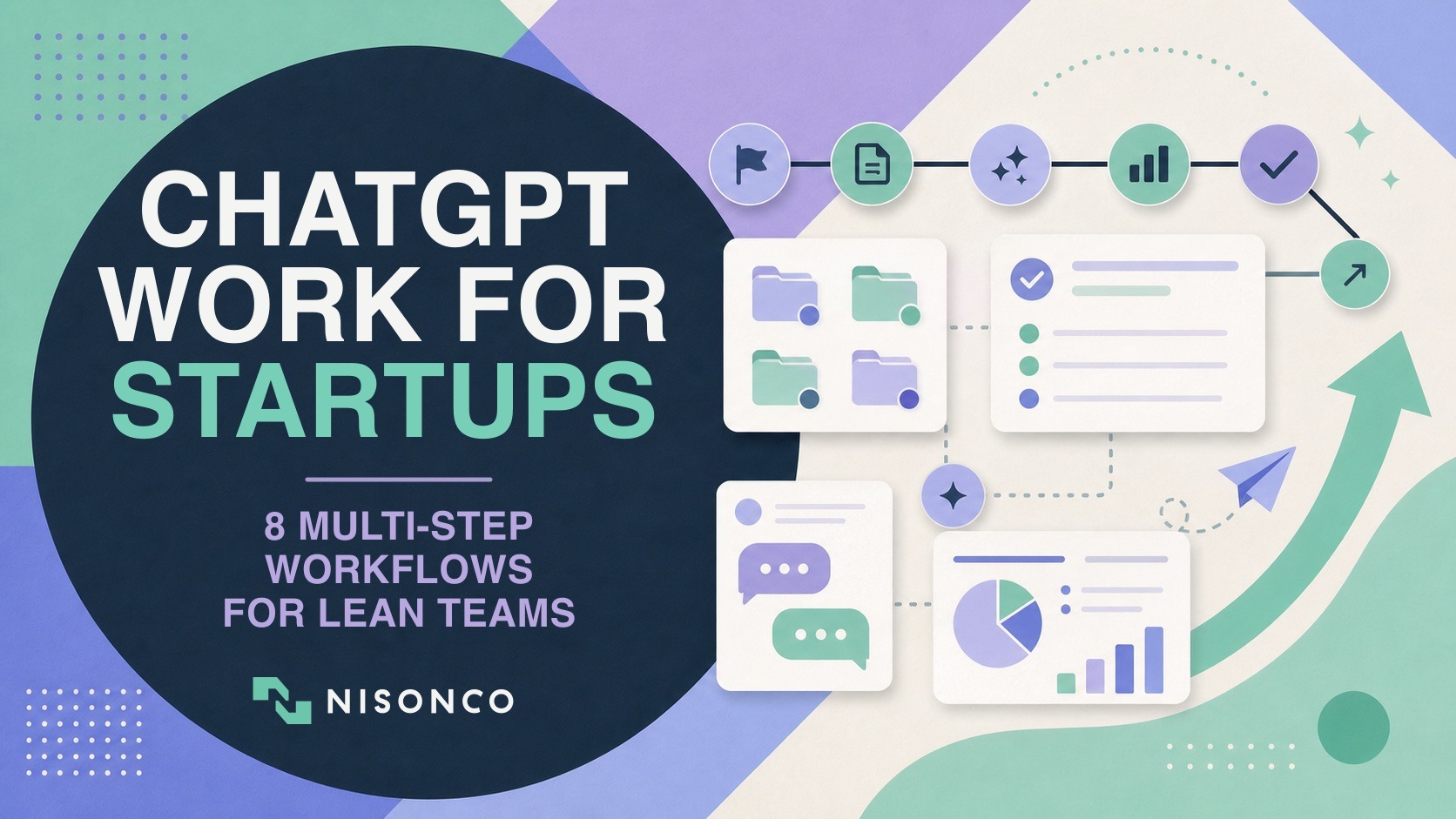
ChatGPT Work is most useful to a startup when it takes ownership of a defined business deliverable, not when it simply generates more text. A lean team can use it to connect research, analysis, drafting, and quality control across a longer task, but the workflow still needs approved sources, a named owner, a definition of done, and a human decision at the end.
Table of Contents
– What Is ChatGPT Work for Startups?
– ChatGPT Work vs ChatGPT, Codex and Deterministic Automation
– How to Design Reliable AI Workflows for a Startup
– Eight Multi-Step Startup Workflows
– Worked Example: A Weekly Founder Operating Brief
– How to Run Parallel AI Workflows Safely
Quick Takeaways
– Choose a workflow because it improves a recurring decision or deliverable, not because it demonstrates an interesting AI capability.
– Give ChatGPT Work a controlled source packet, explicit constraints, exact output format, and a final review gate.
– Use Chat for quick questions, Work for multi-step business deliverables, Codex for software, and ordinary code or automation for predictable rules.
– Measure time to a reviewable result, human review time, error and rework rates, and the business outcome, not words produced.
– Start with read-and-draft access. Expand to external actions only after the workflow is stable, auditable, and owned.
What Is ChatGPT Work for Startups?
OpenAI launched ChatGPT Work in July 2026 as an agent for longer, more complex tasks. According to OpenAI’s introduction, Work can gather information across apps and files, break a project into smaller steps, and create finished materials such as documents, spreadsheets, presentations, and web apps. That is different from asking ChatGPT a question and manually carrying the answer through the rest of the process.
The opportunity for a startup is leverage across the seams. Customer evidence can become a product-decision memo. Approved metrics can become an operating update. A launch goal can become a responsibility map, risk register, and go/no-go packet. The model can keep the pieces connected while a small team remains responsible for the decisions.
Work is not a new reason to automate everything. It follows a usage structure in which longer or more complex tasks can consume more capacity; OpenAI notes that usage varies by task. A five-minute manual process with clear rules may not deserve an agent. A recurring three-hour process that draws from six sources and ends in a consequential decision might.
Availability, tools, connected apps, and local-file access also depend on the plan and surface. At launch, Work on web and mobile runs in the cloud, while desktop Work can use local files and desktop apps with permission. Build each workflow around the environment your team actually has and recheck current product documentation before relying on a capability.
For recurring work, an OpenAI ChatGPT Project can keep related chats, files, and instructions together. Treat that shared context as a maintained source system: give files owners, remove obsolete versions, and remember that project sharing and data controls vary by plan and workspace.
ChatGPT Work vs ChatGPT, Codex and Deterministic Automation
Using the most agentic tool for every problem increases cost and makes predictable processes harder to audit. A reliable startup stack routes each job to the simplest capable system.
Chat
Best for: Questions, brainstorming, light rewrites, quick analysis
Example: Generate five interview questions from an approved hypothesis
Control: Verify facts before use
ChatGPT Work
Best for: Longer business tasks with several sources, stages, and deliverables
Example: Turn interview evidence into a product-decision packet
Control: Source boundary and human approval
Codex
Best for: Repositories, code changes, tests, commands, and technical review
Example: Implement the approved analytics events and return a tested diff
Control: Sandbox, code review, and deployment gate
Deterministic code or automation
Best for: Stable, repeatable rules with known inputs and outputs
Example: Calculate monthly recurring revenue from validated billing rows
Control: Tests, validation, logging, and exception handling
Human specialist
Best for: High-stakes judgment, accountability, negotiation, or regulated advice
Example: Approve employment language, financial reporting, or a legal claim
Control: Qualified professional review
A good workflow often combines these. Code can validate required columns and calculate ratios. Work can explain the changes, connect them to context, and draft a decision memo. A founder can approve the interpretation. This is usually cheaper, faster, and more reliable than asking an AI model to improvise every transformation.
How to Design Reliable AI Workflows for a Startup
Start with a decision, not a topic. “Research competitors” has no stopping condition. “Recommend which of three segments should receive the next six-week sales experiment, using current customer and market evidence” tells the system why the research exists.
Build a source packet. Name the approved files, connected systems, date range, metric definitions, and authoritative source for each fact. Archive stale versions. If web research is allowed, specify the types of sources and the cutoff date.
Separate evidence from inference. Ask Work to label sourced facts, calculations, assumptions, hypotheses, and recommendations. A competitor’s public pricing page is evidence. An interpretation of its go-to-market strategy is inference.
Define the finished artifact. State the audience, sections, tables, file types, decision agenda, and acceptable length. “Review-ready” should mean a named person can approve, reject, or revise the deliverable without reconstructing the process.
Add a quality contract. Require traceability, reproducible calculations, unresolved-question flags, and a final checklist. Tell Work what it may draft and what it may not send, publish, change, or promise.
Name the review gate. The reviewer should be the person accountable for the business decision, not whoever happens to be available. A workflow without an owner becomes a fast way to produce orphaned documents.
Create a review-ready [deliverable] for [audience] to decide [decision]. Use only [approved sources and date range]. Complete [stages]. Keep sourced facts, calculations, assumptions, and recommendations distinct. Return [specific artifacts]. Show the source and reasoning for material conclusions, flag conflicts and missing evidence, and finish with a human review checklist. Do not send, publish, change records, or make external commitments.
8 ChatGPT Workflows for Lean Startup Teams
1. Customer Evidence to a Product Decision
Lean teams often collect interviews, support tickets, surveys, sales objections, and product feedback in different places. The bottleneck is not summary; it is deciding what the evidence supports without flattening disagreement.
Give Work: approved transcripts or notes, segment definitions, the current product hypothesis, known sample limitations, and one decision such as whether to prioritize onboarding, reporting, or a specific integration.
Have it normalize the evidence, remove duplicate records without deleting repeated sentiment, group findings by segment and job, identify contradictions, and create a traceability table. It should distinguish “mentioned by eight interviewees” from “prevalent in the target market.” Those statements are not interchangeable.
The finished packet: an evidence summary, theme-by-segment table, current hypothesis assessment, unresolved questions, two or three decision options, tradeoffs, and the next research plan. A product owner reviews quotes in context and decides whether the sample supports action.
2. Category Research to Defensible Positioning
A competitor roundup becomes useful only when it helps the company choose a position it can actually support. Start with public product, pricing, customer, and messaging evidence plus your own customer research and capabilities.
Ask Work to analyze product scope, audience, pricing model, proof, distribution, and messaging as separate research tracks. Then require a final synthesis that reconciles contradictory findings and labels every inferred strategy. Do not let it turn the absence of a public feature into proof that a competitor lacks it.
The finished packet: a dated category map, consistent competitor profiles with links, repeated claims and conventions, underserved customer needs, and three positioning routes. Each route should state the target, promise, evidence the company can provide, likely objection, operational implication, and what the company would decline to claim.
A founder and customer-facing lead choose the route; legal or subject-matter review covers comparative or regulated claims. The result then becomes an approved input to website, sales, and launch work rather than three teams inventing positioning independently.
3. Founder-Led Sales Account Packet
Personalization can quickly become creepy, inaccurate, or time-consuming. A safer workflow prepares an evidence-based account brief and leaves outreach decisions to the account owner.
Give Work: the target company and role, qualification rules, approved CRM context, current product facts, relevant case evidence, and authorized public or connected sources. Require a citation for factual personalization and a visible label for hypotheses about priorities.
The finished packet: company context, trigger events, stakeholder hypotheses, likely problem areas, qualification questions, a meeting agenda, proof mapped to each problem, a concise follow-up draft, and a proposal outline. Include a “do not mention” section for facts that are technically public but inappropriate or irrelevant.
The salesperson verifies every personal and company detail before use. Work drafts; it does not decide that a prospect has a pain point, update the CRM, send email, or make a commercial promise without explicit authorization and review.
4. One Content Brief to a Search-and-Sales Asset System
A startup does not need more disconnected posts. It needs a useful source asset that answers a real customer question and can be adapted without changing the underlying claim.
Give Work: the approved topic and audience, keyword and search-intent evidence, customer questions, subject-matter input, current product information, brand voice, source requirements, internal-link targets, and prohibited claims. Ask for an evidence outline before prose.
The workflow can produce a long-form article, a sales enablement excerpt, a customer email, a short executive post, and an FAQ, but only after a human approves the source hierarchy. Every adaptation should preserve qualifications and link back to the authoritative asset when appropriate.
The finished packet: research and citation log, content brief, draft, metadata options, internal-link plan, proof-required register, adaptation map, and post-publication measurement plan. Before publishing, run the piece through NisonCo’s free AI tools for metadata, internal-link, E-E-A-T, and AI-search checks, then have a subject owner verify the substance.
5. Launch Goal to a Cross-Functional Operating Plan
Launches fail in the gaps between product, marketing, sales, support, analytics, and legal. ChatGPT Work can make those dependencies visible before the deadline.
Give Work: the launch decision, audience, fixed dates, owners, budget, product readiness, channel constraints, legal requirements, success measures, and known risks. Ask it to identify missing decisions before it generates a schedule.
The finished packet: launch brief, “must launch / can follow / out of scope” decision, responsibility matrix, milestones, dependency map, decision log, risk register, measurement plan, stakeholder update, and go/no-go checklist. Every task should have one accountable owner even when several people contribute.
Work can draft dates based on dependencies; the people doing the work must confirm them. The launch owner controls scope and go/no-go. Product, legal, analytics, and customer-facing owners approve their criteria instead of treating the generated plan as a commitment.
6. Validated Metrics to a Board or Investor Update
Boards do not need a longer dashboard. They need a clear view of performance, causal uncertainty, risks, decisions, and asks. The calculations and narrative should remain separable so the prose cannot hide a data problem.
Use deterministic preparation first: validate required fields, date ranges, duplicates, currency, and metric definitions; calculate agreed ratios using code or a controlled spreadsheet; reconcile totals to the source system. Then give Work the validated output, prior reports, forecast, material events, and reporting conventions.
The finished packet: KPI table, period and forecast variance, operating narrative, cohort or segment observations where valid, risks, decisions, asks, appendix, and draft presentation. Require Work to show which source supports every number and to flag apparent explanations as hypotheses unless evidence establishes cause.
The finance or operations owner reproduces material calculations and reconciles the report. Founders approve the narrative and any forward-looking statement. Work should never invent missing figures or silently harmonize conflicting metric definitions.
7. Hiring Need to a Structured Selection and Onboarding System
Copying a generic job description usually produces a vague role and an inconsistent interview. Start with the business outcomes the hire must own.
Give Work: company goals, current team responsibilities, work that is not being done, success measures, compensation constraints, approved employment language, interview capacity, and onboarding resources. Ask it to identify whether the need is a full-time role, fractional help, a contractor, or process improvement before assuming a hire.
The finished packet: role scorecard, job-description draft, structured interview plan, job-related questions, evaluation rubric, work-sample brief, reference-check guide, decision record, and 30-60-90-day onboarding plan. Use the same scored criteria for candidates in comparable stages.
The hiring manager owns the outcomes and selection. A qualified HR or legal reviewer checks jurisdiction-specific language, accessibility, candidate-data handling, compensation requirements, and risks of bias. The model can structure evidence; it should not make the employment decision.
8. Repeated Founder Process to a Tested SOP
A process is not ready for automation merely because one person can describe it. Hidden exceptions, undocumented permissions, and judgment calls must be found first.
Give Work: recordings or notes from several real runs, source policies, roles, systems, quality criteria, exception cases, known failures, and examples of correct and incorrect outputs. Ask it to separate official policy, current habit, and unresolved judgment.
The finished packet: current-state map, inputs and outputs, step-by-step SOP, decision points, exception guide, responsibility matrix, quality checks, permission requirements, training exercise, and improvement backlog. Test the draft against routine and edge cases before automating any step.
The process owner approves every policy interpretation. Stable transformations can move into deterministic automation; ambiguous classification may stay with Work; sensitive approval remains human. This decomposition is often more dependable than one end-to-end AI agent.
Worked Example: A Weekly Founder Operating Brief
Imagine an eight-person B2B startup where the founder spends Friday afternoon assembling sales, product, cash, hiring, and customer updates. Different teams use different definitions, the memo arrives late, and the meeting becomes a debate about numbers.
First, fix the source layer. Operations defines the reporting period and authoritative system for each metric. A script validates the exports, rejects missing or duplicate records, and calculates agreed metrics. Team owners add short notes for changes the data cannot explain.
Then, give Work a narrow job. It receives validated tables, team notes, the previous brief, current quarterly goals, and the decision agenda. It compares the periods, highlights material changes, connects blockers across teams, identifies contradictory explanations, and drafts the operating brief.
Scorecard
Required output: Current value, target, prior value, variance, source
Human check: Operations reconciles calculations
What changed
Required output: Material movements with evidence and confidence label
Human check: Functional owner confirms context
Risks and blockers
Required output: Owner, impact, dependency, next decision date
Human check: Owner accepts or revises
Decisions
Required output: Options, tradeoffs, recommendation, decision owner
Human check: Founder decides in the meeting
Commitments
Required output: Owner, deliverable, date, verification method
Human check: Owner explicitly confirms
Finally, measure the workflow. Track preparation time, review time, corrections found, meeting time spent resolving definitions, overdue commitments, and whether the memo changed a decision. If review takes as long as the old manual process, improve the source packet and definition of done before adding more automation.
How to Run Parallel AI Workflows Safely
Parallel research is valuable when scopes are genuinely independent: one task per competitor, customer segment, geographic market, or launch workstream. It is less useful when each track depends on an evolving shared judgment, because the team receives multiple polished answers built on different assumptions.
Use one shared contract. Give every parallel track the same date boundary, definitions, evidence standard, prohibited claims, and output schema.
Keep scopes nonoverlapping. If two tracks answer the same question, say whether the purpose is independent verification. Otherwise, duplication increases usage without increasing confidence.
Require a synthesis owner. The final task should compare results, resolve or expose conflicts, remove duplication, and cite the underlying source, not simply concatenate summaries. A person approves the synthesis criteria and reviews disagreements that change the decision.
Parallelism is an economic choice. Use it when speed, breadth, or independent checking is worth the extra usage and review burden. For a small, sequential task, one well-grounded thread is often better.
Governance That a Small Team Can Actually Maintain
A startup does not need a 40-page AI policy to pilot one workflow. It does need clear answers about data, permissions, approvals, and failure handling. Teams that need a broader risk framework can use the NIST AI Risk Management Framework and its generative-AI profile as a reference, then scale the controls to the actual use case.
Data boundary: Specify what may be uploaded or connected, how personal and confidential information is minimized, which account and workspace settings apply, and when data must remain in its source system.
Permission boundary: Begin with read and draft. Add write, send, publish, schedule, or execute permissions only for a stable workflow with logs, a named owner, and a rollback or correction path.
Approval boundary: Name actions that always require a person: public claims, customer communication, financial reporting, hiring decisions, legal or regulated content, production deployment, record deletion, and material commitments.
Quality boundary: Define acceptable error and rework rates, required sources, calculations that must be reproducible, and conditions that stop the workflow. “Insufficient evidence” is a valid output.
Ownership boundary: Assign a workflow owner, source owners, reviewers, and the person who monitors usage and value. Revisit the workflow when tools, connected apps, permissions, source systems, or business definitions change.
A 30-Day ChatGPT Workflow Rollout Plan
Week 1: Choose and baseline. Select one recurring, high-value task with accessible inputs and an output a person can judge. Record current preparation time, review time, error rate, rework, and business outcome. Do not choose a high-risk external action as the first pilot.
Week 2: Build the source packet and contract. Clean the approved inputs, define terms, write the output schema, assign owners, and run several historical examples. Record where Work needs clarification or invents unsupported connections.
Week 3: Run live with full review. Use the workflow on real work but review every result. Compare it with the baseline. Fix sources and deterministic validation before endlessly expanding the prompt.
Week 4: Decide whether to scale. Keep, revise, or stop the workflow based on time saved after review, error and rework rates, usage cost, team adoption, and business value. Document the stable version before adding connected systems, parallel tracks, scheduling, or broader permissions.
The quality bar is not “the AI completed the task.” It is “the team received a trustworthy, reviewable deliverable faster, with clear ownership and acceptable risk.”
If you want help choosing the right first workflow, designing the source and approval system, or deciding what should use Work, Codex, deterministic automation, or a human specialist, NisonCo’s AI consulting services can turn a broad AI goal into a controlled operating process. Startup marketing teams can also explore NisonCo’s AI marketing consulting and free AI tools.