ChatGPT Ads are becoming more than a sponsored link beside an AI answer. OpenAI is testing Sponsored Agents, which let a person choose to start a clearly labeled conversation with a business after clicking an ad.
That creates a new marketing surface, but it does not create a proven channel overnight. The current announcement tells us how the format is supposed to work. It does not tell us what a click will cost, how much reach most advertisers will get, which industries will qualify, or whether the format will outperform search and social ads.
The practical move is to prepare a careful test, not to invent a forecast.
Product behavior and availability were checked September 22, 2026. Sponsored Agents are being tested with select advertisers in the United States, and launch details can change quickly.
Quick Takeaways
- OpenAI announced Sponsored Agents, natural-language campaign management, AI creative assistance, text customization, and integrations with HubSpot and Shopify.
- A Sponsored Agent is an optional business-sponsored conversation that starts after an ad click. OpenAI says it is clearly labeled and separate from ChatGPT's independent answer and the user's original conversation.
- The creative job now includes the conversation after the click, not only the headline, image, and landing page.
- Marketers need approved source material, claims rules, escalation paths, and conversion tracking before they hand customer questions to a sponsored agent.
- Pricing, general availability, complete category eligibility, and independent performance benchmarks remain open questions.
- Regulated businesses should confirm eligibility before budgeting. OpenAI's initial ads principles excluded ads near certain sensitive or regulated topics, but did not publish a complete current category list.
Related NisonCo resources: AI agents for business, AI marketing services, and AI consulting services.
What OpenAI actually announced
In its September 16 announcement, OpenAI introduced several new ChatGPT Ads capabilities:
- Sponsored Agents that a user can choose to open after clicking an ad;
- an Ads Manager plugin for creating, updating, and analyzing campaigns with natural-language instructions;
- AI suggestions for ad copy and imagery inside Ads Manager;
- optional text customization that can adapt existing headlines and descriptions to the conversation and translate them;
- a HubSpot integration for campaign management and lead follow-up;
- a Shopify app for syncing a product catalog, creating campaigns, measuring conversions, and tracking performance.
OpenAI says Sponsored Agents are currently being tested with select advertisers in the United States. That detail matters. This is not yet a channel every marketer should assume they can buy at scale.
The Shopify integration is more concrete for eligible merchants. The ChatGPT Ads app listing describes catalog sync, campaign creation, conversion measurement, and campaign management inside Shopify. Even there, a marketer still needs to review the app's requested data access, store eligibility, tracking setup, and product-feed quality before connecting it.
What makes a Sponsored Agent different
A conventional ad often asks the visitor to make a large jump. The person sees a short message, clicks, and lands on a page that has to anticipate every important question.
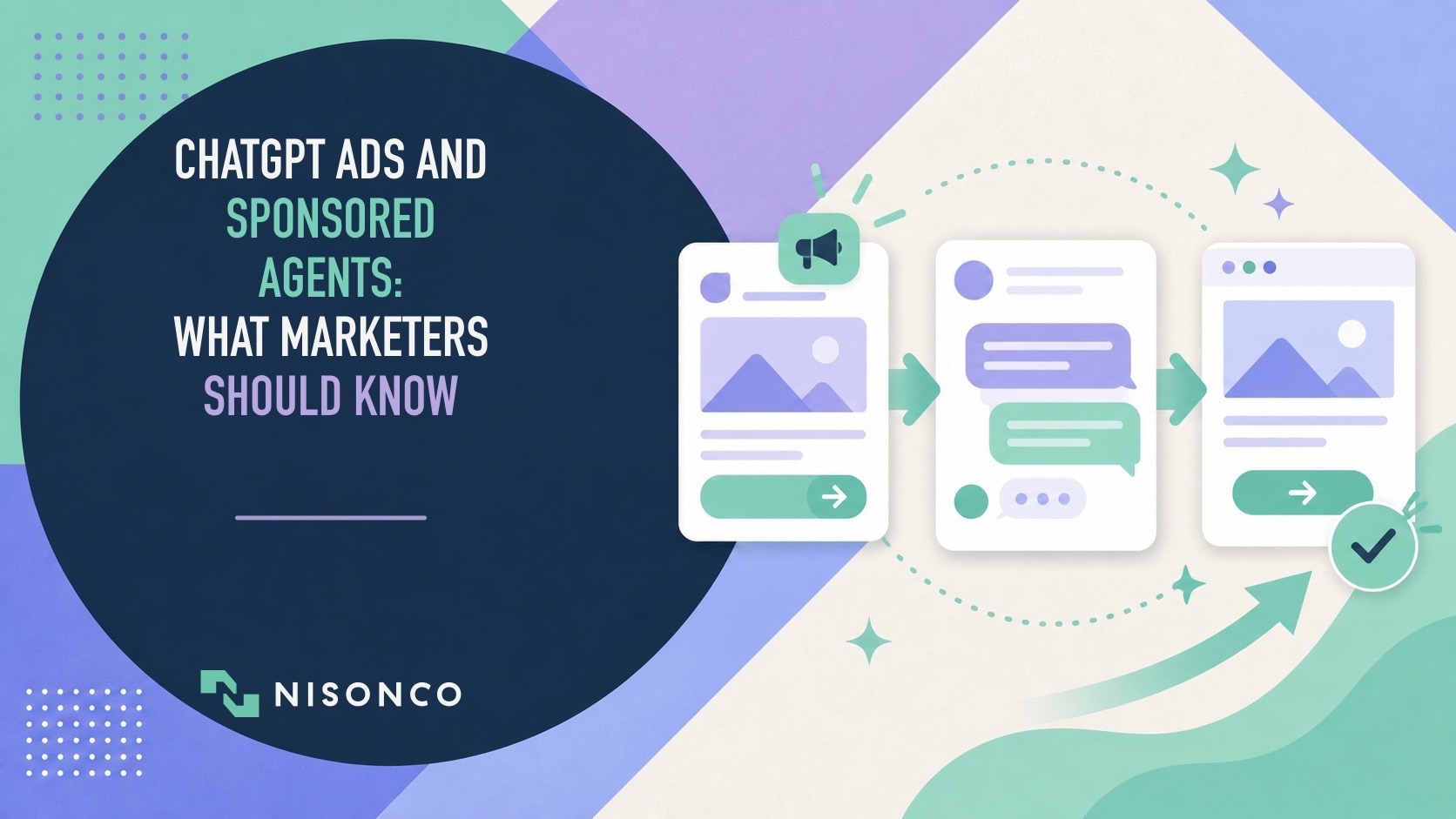
A Sponsored Agent adds a conversational step. A prospective customer might ask whether a product fits a specific use case, how two options differ, what is included, or what should happen next. The agent can respond inside ChatGPT and link to the advertiser's website when the person is ready.
OpenAI says this sponsored conversation is distinct from ChatGPT's independent answer and separate from the original conversation. That distinction should remain obvious throughout the experience. The FTC's native-advertising guidance focuses on the net impression a paid format creates and says disclosures needed to prevent deception should be clear and prominent. A conversational format does not remove ordinary truth-in-advertising responsibilities.
For marketers, the important change is that the conversation itself becomes part of the creative.
The ad is no longer the whole message
If a campaign uses a Sponsored Agent, the customer experience can include at least four layers:
- the independent ChatGPT answer;
- the clearly labeled ad;
- the optional sponsored conversation;
- the advertiser's site, form, store, or sales handoff.
Each layer can create or lose trust.
A strong headline cannot rescue an agent that gives an outdated price. A polished sponsored conversation cannot rescue a landing page that contradicts it. A useful answer still needs a clean handoff when a question requires a person.
This makes product and service information part of campaign operations. Before launch, the advertiser should know which source controls pricing, availability, features, eligibility, disclaimers, guarantees, and escalation. If those facts are scattered across an old website, a sales deck, and several internal documents, the agent may expose the inconsistency faster than the marketing team can fix it.
Six things to prepare before spending
1. A source-of-truth packet
Give the sponsored experience a small set of approved, current sources. Include the product or service description, pricing rules, availability, common questions, exclusions, required disclaimers, and approved next steps.
Do not solve conflicting source material by adding more of it. Name the authoritative source for each volatile fact and assign an owner who can update it.
2. An answer boundary
Decide which questions the agent may answer, which require a qualified person, and which it should decline.
The answer boundary should be especially conservative for medical, legal, financial, safety, eligibility, guarantee, and regulated-product questions. A human handoff is part of a good experience, not evidence that the agent failed.
3. A claims review
Review the questions customers are likely to ask, not only the claims that appear in the ad. A sponsored conversation can produce more words than a static placement, which creates more opportunities for an unsupported comparison, an outdated detail, or an answer that sounds like a guarantee.
Build a small test set of difficult questions before launch. Include ambiguous requests, missing information, comparisons, objections, and questions that should trigger escalation.
4. A landing-page and handoff check
The agent should send people to the next logical step, not a generic homepage by default. Match the destination to the intent of the conversation.
Test whether the linked page repeats the important facts, works on a phone, loads quickly, and makes the next action clear. If a lead moves into HubSpot or another CRM, verify consent, field mapping, routing, and ownership before real leads arrive.
5. A measurement plan
Do not judge the pilot on click-through rate alone. A conversational ad may change what happens between the click and the site visit.
Useful measures may include:
- sponsored conversations started;
- questions answered without correction;
- handoffs to a person;
- qualified site visits;
- completed forms, calls, or purchases;
- cost per accepted lead or sale;
- common unanswered questions;
- human review and correction time.
Some of these measures may not be available in the product exactly as written. Confirm the actual reporting fields before finalizing the scorecard.
6. A stop rule
Set a budget cap, test window, minimum sample, and failure condition before launch. Pause if the agent repeatedly gives unsupported answers, sends people to the wrong destination, creates compliance concerns, or cannot produce usable conversion data.
The purpose of an early pilot is to learn whether the channel deserves a larger test. It is not to defend the decision to try it.
What the HubSpot and Shopify integrations change
The first partner integrations reduce some operational friction. Shopify merchants can connect product information and manage campaigns from a familiar system. HubSpot users can connect a ChatGPT Ads account, track performance, and follow up on leads using CRM context.
That convenience does not remove the need for data governance. Review which customer, staff, product, marketing, and analytics data an integration can access or change. Use the narrowest workable permissions, document who owns the connection, and decide how it will be revoked if the test ends.
The integrations also make source quality more important. A clean product catalog and disciplined CRM are assets. Duplicate records, outdated lifecycle stages, and inconsistent product fields can become campaign problems.
What marketers still do not know
The current evidence does not answer several budget questions:
- What will typical pricing and auction dynamics look like?
- Which targeting controls and exclusions will be available to most advertisers?
- How much inventory will exist outside the initial U.S. test?
- Which industries, products, and claims will be eligible?
- How will Sponsored Agent performance be reported?
- What is a useful benchmark for a conversation start, qualified visit, or conversion?
- How often will AI text customization materially change an advertiser's approved copy?
Those gaps are reasons to narrow the first test. They are not reasons to pretend the channel has no potential.
A special caution for regulated industries
OpenAI's January 2026 advertising principles said the initial test would not show ads near certain sensitive or regulated topics, including health, mental health, and politics. The September product announcement does not provide a complete current category list.
Cannabis and other regulated businesses should not infer eligibility from silence. Ask for the current written policy, confirm the product and destination are allowed, and keep conventional legal and platform review in the process. A wait-and-verify decision is better than building a campaign the platform cannot run.
The bottom line
ChatGPT Ads introduce a real change in paid media: a person may be able to move from an ad into a business-sponsored conversation without leaving ChatGPT.
That can make product discovery more useful, but it also expands the marketer's responsibility. The campaign now depends on source quality, answer boundaries, truthful claims, permission design, human escalation, landing-page consistency, and measurement after the conversation begins.
Prepare those pieces before you spend. Then, if access and policy fit, run a small test with a fixed budget and a decision rule that includes usable business outcomes, not only clicks.